EGYPTIAN
ARCHAEOLOGY
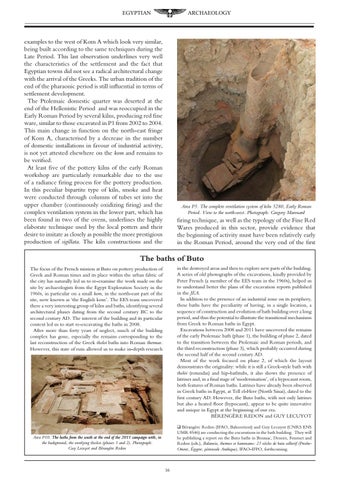
examples to the west of Kom A which look very similar, being built according to the same techniques during the Late Period. This last observation underlines very well the characteristics of the settlement and the fact that Egyptian towns did not see a radical architectural change with the arrival of the Greeks. The urban tradition of the end of the pharaonic period is still influential in terms of settlement development. The Ptolemaic domestic quarter was deserted at the end of the Hellenistic Period and was reoccupied in the Early Roman Period by several kilns, producing red fine ware, similar to those excavated in P1 from 2002 to 2004. This main change in function on the north-east fringe of Kom A, characterised by a decrease in the number of domestic installations in favour of industrial activity, is not yet attested elsewhere on the kom and remains to be verified. At least five of the pottery kilns of the early Roman workshop are particularly remarkable due to the use of a radiance firing process for the pottery production. In this peculiar bipartite type of kiln, smoke and heat were conducted through columns of tubes set into the upper chamber (continuously oxidizing firing) and the complex ventilation system in the lower part, which has been found in two of the ovens, underlines the highly elaborate technique used by the local potters and their desire to imitate as closely as possible the more prestigious production of sigillata. The kiln constructions and the
Area P5. The complete ventilation system of kiln 5280, Early Roman Period. View to the north-west. Photograph: Gregory Marouard
firing technique, as well as the typology of the Fine Red Wares produced in this sector, provide evidence that the beginning of activity must have been relatively early in the Roman Period, around the very end of the first
The baths of Buto in the destroyed areas and then to explore new parts of the building. A series of old photographs of the excavations, kindly provided by Peter French (a member of the EES team in the 1960s), helped us to understand better the plans of the excavation reports published in the JEA. In addition to the presence of an industrial zone on its periphery, these baths have the peculiarity of having, in a single location, a sequence of construction and evolution of bath building over a long period, and thus the potential to illustrate the transitional mechanisms from Greek to Roman baths in Egypt. Excavations between 2008 and 2011 have uncovered the remains of the early Ptolemaic bath (phase 1), the building of phase 2, dated to the transition between the Ptolemaic and Roman periods, and the third reconstruction (phase 3), which probably occurred during the second half of the second century AD. Most of the work focused on phase 2, of which the layout demonstrates the originality: while it is still a Greek-style bath with tholoi (rotundas) and hip-bathtubs, it also shows the presence of latrines and, in a final stage of ‘modernisation’, of a hypocaust room, both features of Roman baths. Latrines have already been observed in Greek baths in Egypt, at Tell el-Herr (North Sinai), dated to the first century AD. However, the Buto baths, with not only latrines but also a heated floor (hypocaust), appear to be quite innovative and unique in Egypt at the beginning of our era. BÉRENGÈRE REDON and GUY LECUYOT
The focus of the French mission at Buto on pottery production of Greek and Roman times and its place within the urban fabric of the city has naturally led us to re-examine the work made on the site by archaeologists from the Egypt Exploration Society in the 1960s, in particular on a small kom, in the north-east part of the site, now known as ‘the English kom’. The EES team uncovered there a very interesting group of kilns and baths, identifying several architectural phases dating from the second century BC to the second century AD. The interest of the building and its particular context led us to start re-excavating the baths in 2008. After more than forty years of neglect, much of the building complex has gone, especially the remains corresponding to the last reconstruction of the Greek tholoi baths into Roman thermae. However, this state of ruin allowed us to make in-depth research
q Bérangère Redon (IFAO, Balneorient) and Guy Lecuyot (CNRS ENS UMR 8546) are conducting the excavations in the bath building. They will be publishing a report on the Buto baths in Boussac, Denoix, Fournet and Redon (eds.), Balaneia, thermes et hammams: 25 siècles de bain collectif (ProcheOrient, Égypte, péninsule Arabique), IFAO-IFPO, forthcoming.
Area P10. ������������������������������������������������������������������ The baths from the south at the end of the 2011 campaign with, in the background, the overlying tholoi (phases 1 and 2). Photograph: Guy Lecuyot and Bérangère Redon
16