EGYPTIAN
ARCHAEOLOGY
Terracottas from Tell Basta The Tell Basta expedition is now a joint project of the EES, the University of Göttingen and the SCA (see EA 39, pp.7-9), Veit Vaelske is responsible for study of the terracottas found during the work and summarises his results to date. John Gardner Wilkinson (1797-1875) visited Tell Basta in the early nineteenth century and later remarked: ‘In the mounds I found a few copper coins of late Roman time, some small fragments of marble, and a piece of red pottery representing the god of death or war, whose figure occurs on the columns of the Mammisi temples, usually supposed to be Typhonian.’ (Modern Egypt and Thebes; being a description of Egypt (1843), p.430). Like many of his contemporaries Wilkinson collected some of the plentiful objects from the site and brought them back to England, but of greater academic value is his reference to their place of origin, which emphasises the relevance not only of excavating this special city of the Delta but also of keeping in mind the long history of modern research at the site. Since Wilkinson’s time, Tell Basta has yielded an endless series of terracottas (clay figurines) and research on this material is especially valuable since they were very popular in Graeco-Roman times and can offer special insights into the religious and cultural conditions of Tell Basta/Bubastis. It addition to other iconographic materials such as limestone statuettes, faience amulets, etc. the Tell Basta Project has discovered almost 400 fragments of terracottas. Similar material found by earlier archaeological expeditions and collectors easily doubles this number, although many of the previously-found terracottas lack accurate find spots and archaeological contexts. In addition to studying iconography and style, modern scientific excavation helps to provenance all the material more accurately.
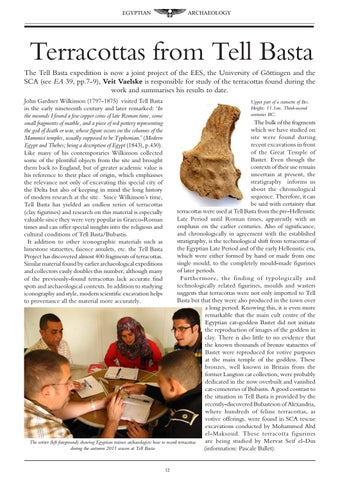
Upper part of a statuette of Bes. Height: 11.1cm. Third-second centuries BC.
The bulk of the fragments which we have studied on site were found during recent excavations in front of the Great Temple of Bastet. Even though the contexts of their use remain uncertain at present, the stratigraphy informs us about the chronological sequence. Therefore, it can be said with certainty that terracottas were used at Tell Basta from the pre-Hellenistic Late Period until Roman times, apparently with an emphasis on the earlier centuries. Also of significance, and chronologically in agreement with the established stratigraphy, is the technological shift from terracottas of the Egyptian Late Period and of the early Hellenistic era, which were either formed by hand or made from one single mould, to the completely mould-made figurines of later periods. Furthermore, the finding of typologically and technologically related figurines, moulds and wasters suggests that terracottas were not only imported to Tell Basta but that they were also produced in the town over a long period. Knowing this, it is even more remarkable that the main cult centre of the Egyptian cat-goddess Bastet did not initiate the reproduction of images of the goddess in clay. There is also little to no evidence that the known thousands of bronze statuettes of Bastet were reproduced for votive purposes at the main temple of the goddess. These bronzes, well known in Britain from the former Langton cat collection, were probably dedicated in the now overbuilt and vanished cat-cemeteries of Bubastis. A good contrast to the situation in Tell Basta is provided by the recently-discovered Bubasteion of Alexandria, where hundreds of feline terracottas, as votive offerings, were found in SCA rescue excavations conducted by Mohammed Abd el-Maksoud. These terracotta figurines are being studied by Mervat Seif el-Din The writer (left foreground) showing Egyptian trainee archaeologists how to record terracottas during the autumn 2011 season at Tell Basta (information: Pascale Ballet).
12