EGYPTIAN
ARCHAEOLOGY
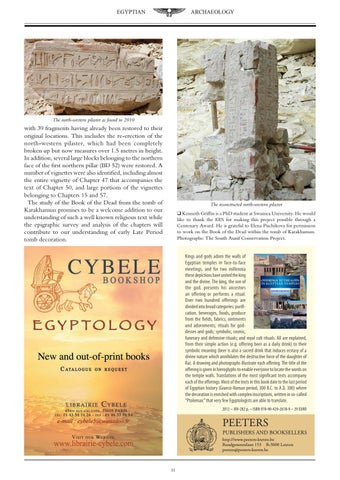
The north-western pilaster as found in 2010
with 39 fragments having already been restored to their original locations. This includes the re-erection of the north-western pilaster, which had been completely broken up but now measures over 1.5 metres in height. In addition, several large blocks belonging to the northern face of the first northern pillar (BD 52) were restored. A number of vignettes were also identified, including almost the entire vignette of Chapter 47 that accompanies the text of Chapter 50, and large portions of the vignettes belonging to Chapters 15 and 57. The study of the Book of the Dead from the tomb of Karakhamun promises to be a welcome addition to our understanding of such a well known religious text while the epigraphic survey and analysis of the chapters will contribute to our understanding of early Late Period tomb decoration.
The reconstructed north-western pilaster q Kenneth Griffin is a PhD student at Swansea University. He would like to thank the EES for making this project possible through a Centenary Award. He is grateful to Elena Pischikova for permission to work on the Book of the Dead within the tomb of Karakhamun. Photographs: The South Asasif Conservation Project.
Kings and gods adorn the walls of Egyptian temples in face-to-face meetings, and for two millennia these depictions have united the king OFFERINGS TO THE GODS and the divine. The king, the son of IN EGYPTIAN TEMPLES the god, presents his ancestors an offering or performs a ritual. Over two hundred offerings are divided into broad categories: purification, beverages, foods, produce from the fields, fabrics, ointments and adornments; rituals for goddesses and gods; symbolic, cosmic, funerary and defensive rituals; and royal cult rituals. All are explained, from their simple action (e.g. offering beer as a daily drink) to their symbolic meaning (beer is also a sacred drink that induces ecstasy of a divine nature which annihilates the destructive force of the daughter of Ra). A drawing and photographs illustrate each offering. The title of the offering is given in hieroglyphs to enable everyone to locate the words on the temple walls. Translations of the most significant texts accompany each of the offerings. Most of the texts in this book date to the last period of Egyptian history (Graeco-Roman period, 300 B.C. to A.D. 300) where the decoration is enriched with complex inscriptions, written in so-called “Ptolemaic” that very few Egyptologists are able to translate. SYLVIE CAUVILLE
2012 – XIV-282 p. – ISBN 978-90-429-2618-9 – 29 EURO
Peeters
Publishers and booksellers http://www.peeters-leuven.be bondgenotenlaan 153 b-3000 leuven peeters@peeters-leuven.be
95262_Cauville_adv_85x130mm.indd 1 11
24/01/12 11:43