EGYPTIAN
ARCHAEOLOGY
The Book of the Dead in the tomb of Karakhamun In 2010 a grant from the EES Centenary Fund was awarded to Kenneth Griffin to study the Book of the Dead in the Second Pillared Hall of the Theban tomb of Karakhamun, as he now describes. The tomb of Karakhamun (TT 223), situated in the South Asasif necropolis, represents one of the earliest monumental tombs of the Late Period. Dating to the mid Twenty-Fifth Dynasty, the tomb was an innovation of the time, with its entry pylon, large open courts and shrines, marking a dramatic change from the smaller enclosed tombs of the New Kingdom. The tomb was first explored in the first half of the nineteenth century, but had since been neglected, mainly due to its poor state of preservation. Excavations, carried out over the past six seasons, under the direction of Elena Pischikova and the SCA-sponsored South Asasif Conservation Project, have resulted in the recovery from the floor of the tomb of the vast majority of the inscribed wall fragments. It is now known that the walls of the tomb were inscribed with a number of religious texts including the Book of the Dead, Pyramid Texts, and the Hours of both the Day and the Night (Stundenritual). Many of these texts were also replicated in the later Kushite and Saite tombs at Thebes, making Karakhamun’s tomb essential to the study of the evolution of these religious texts. During the summer of 2011, a project to identify, reconstruct, and record the chapters of the Book of the Dead from the Second Pillared Hall of the tomb was undertaken with the support of the EES Centenary Fund. This hall consists of four pillars and four pilasters that are all inscribed with vertical columns of hieroglyphs: seven on the long sides and four on the short sides. As a rule, the Book of the Dead chapters are written retrograde so that the signs are orientated towards the rear of the tomb while equally having the appearance of beginning from there - a practice attested in other Late Period tombs. The titles of the spells are not included and instead, each text is introduced by the phrase ‘words spoken by the
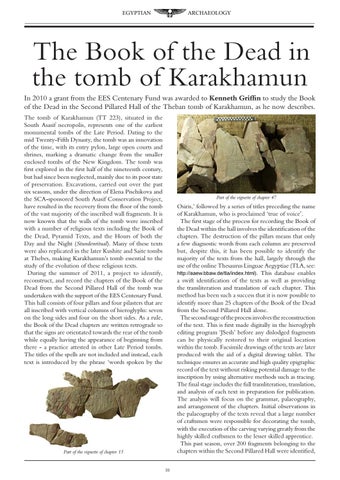
Part of the vignette of chapter 47
Osiris,’ followed by a series of titles preceding the name of Karakhamun, who is proclaimed ‘true of voice’. The first stage of the process for recording the Book of the Dead within the hall involves the identification of the chapters. The destruction of the pillars means that only a few diagnostic words from each column are preserved but, despite this, it has been possible to identify the majority of the texts from the hall, largely through the use of the online Thesaurus Linguae Aegyptiae (TLA, see: http://aaew.bbaw.de/tla/index.html). This database enables a swift identification of the texts as well as providing the transliteration and translation of each chapter. This method has been such a success that it is now possible to identify more than 25 chapters of the Book of the Dead from the Second Pillared Hall alone. The second stage of the process involves the reconstruction of the text. This is first made digitally in the hieroglyph editing program ‘JSesh’ before any dislodged fragments can be physically restored to their original location within the tomb. Facsimile drawings of the texts are later produced with the aid of a digital drawing tablet. The technique ensures an accurate and high quality epigraphic record of the text without risking potential damage to the inscription by using alternative methods such as tracing. The final stage includes the full transliteration, translation, and analysis of each text in preparation for publication. The analysis will focus on the grammar, palaeography, and arrangement of the chapters. Initial observations in the palaeography of the texts reveal that a large number of craftsmen were responsible for decorating the tomb, with the execution of the carving varying greatly from the highly skilled craftsmen to the lesser skilled apprentice. This past season, over 200 fragments belonging to the chapters within the Second Pillared Hall were identified,
Part of the vignette of chapter 15
10