EGYPTIAN
ARCHAEOLOGY
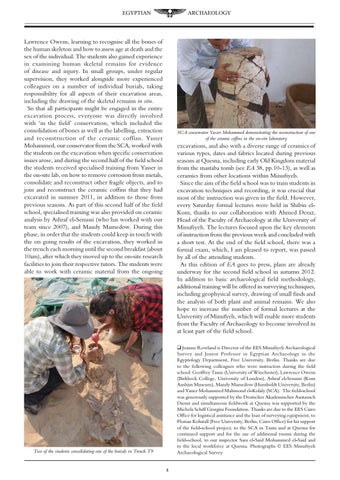
Lawrence Owens, learning to recognise all the bones of the human skeleton and how to assess age at death and the sex of the individual. The students also gained experience in examining human skeletal remains for evidence of disease and injury. In small groups, under regular supervision, they worked alongside more experienced colleagues on a number of individual burials, taking responsibility for all aspects of their excavation areas, including the drawing of the skeletal remains in situ. So that all participants might be engaged in the entire excavation process, everyone was directly involved with ‘in the field’ conservation, which included the consolidation of bones as well as the labelling, extraction and reconstruction of the ceramic coffins. Yasser Mohammed, our conservator from the SCA, worked with the students on the excavation when specific conservation issues arose, and during the second half of the field school the students received specialised training from Yasser in the on-site lab, on how to remove corrosion from metals, consolidate and reconstruct other fragile objects, and to join and reconstruct the ceramic coffins that they had excavated in summer 2011, in addition to those from previous seasons. As part of this second half of the field school, specialised training was also provided on ceramic analysis by Ashraf el-Senussi (who has worked with our team since 2007), and Mandy Mamedow. During this phase, in order that the students could keep in touch with the on going results of the excavation, they worked in the trench each morning until the second breakfast (about 10am), after which they moved up to the on-site research facilities to join their respective tutors. The students were able to work with ceramic material from the ongoing
SCA conservator Yasser Mohammed demonstrating the reconstruction of one of the ceramic coffins in the on-site laboratory
excavations, and also with a diverse range of ceramics of various types, dates and fabrics located during previous seasons at Quesna, including early Old Kingdom material from the mastaba tomb (see EA 38, pp.10-13), as well as ceramics from other locations within Minufiyeh. Since the aim of the field school was to train students in excavation techniques and recording, it was crucial that most of the instruction was given in the field. However, every Saturday formal lectures were held in Shibin elKom, thanks to our collaboration with Ahmed Deraz, Head of the Faculty of Archaeology at the University of Minufiyeh. The lectures focused upon the key elements of instruction from the previous week and concluded with a short test. At the end of the field school, there was a formal exam, which, I am pleased to report, was passed by all of the attending students. As this edition of EA goes to press, plans are already underway for the second field school in autumn 2012. In addition to basic archaeological field methodology, additional training will be offered in surveying techniques, including geophysical survey, drawing of small finds and the analysis of both plant and animal remains. We also hope to increase the number of formal lectures at the University of Minufyeh, which will enable more students from the Faculty of Archaeology to become involved in at least part of the field school. q Joanne Rowland is Director of the EES Minufiyeh Archaeological Survey and Junior Professor in Egyptian Archaeology in the Egyptology Department, Free University, Berlin. Thanks are due to the following colleagues who were instructors during the field school: Geoffrey Tassie (University of Winchester), Lawrence Owens (Birkbeck College, University of London), Ashraf el-Senussi (Kom Aushim Museum), Mandy Mamedow (Humboldt University, Berlin) and Yasser Mohammed Mahmoud el-Kolaly (SCA). The field-school was generously supported by the Deutscher Akademischer Austausch Dienst and simultaneous fieldwork at Quesna was supported by the Michela Schiff Giorgini Foundation. Thanks are due to the EES Cairo Office for logistical assistance and the loan of surveying equipment, to Florian Kohstall (Free University, Berlin, Cairo Office) for his support of the field-school project, to the SCA in Tanta and at Quesna for continued support and for the use of additional rooms during the field-school, to our inspector Sara el-Said Mohammed el-Said and to the local workforce at Quesna. Photographs © EES Minufiyeh Archaeological Survey
Two of the students consolidating one of the burials in Trench T9