EGYPTIAN
ARCHAEOLOGY
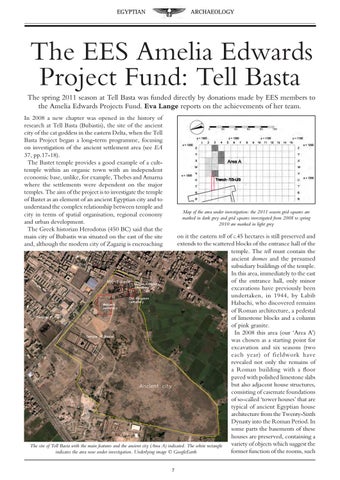
The EES Amelia Edwards Project Fund: Tell Basta The spring 2011 season at Tell Basta was funded directly by donations made by EES members to the Amelia Edwards Projects Fund. Eva Lange reports on the achievements of her team. In 2008 a new chapter was opened in the history of research at Tell Basta (Bubastis), the site of the ancient city of the cat goddess in the eastern Delta, when the Tell Basta Project began a long-term programme, focusing on investigation of the ancient settlement area (see EA 37, pp.17-18). The Bastet temple provides a good example of a culttemple within an organic town with an independent economic base, unlike, for example, Thebes and Amarna where the settlements were dependent on the major temples. The aim of the project is to investigate the temple of Bastet as an element of an ancient Egyptian city and to understand the complex relationship between temple and city in terms of spatial organisation, regional economy and urban development. The Greek historian Herodotus (450 BC) said that the main city of Bubastis was situated on the east of the site and, although the modern city of Zagazig is encroaching
Map of the area under investigation: the 2011 season grid squares are marked in dark grey and grid squares investigated from 2008 to spring 2010 are marked in light grey
on it the eastern tell of c.45 hectares is still preserved and extends to the scattered blocks of the entrance hall of the temple. The tell must contain the ancient dromos and the presumed subsidiary buildings of the temple. In this area, immediately to the east of the entrance hall, only minor excavations have previously been undertaken, in 1944, by Labib Habachi, who discovered remains of Roman architecture, a pedestal of limestone blocks and a column of pink granite. In 2008 this area (our ‘Area A’) was chosen as a starting point for excavation and six seasons (two each year) of fieldwork have revealed not only the remains of a Roman building with a floor paved with polished limestone slabs but also adjacent house structures, consisting of casemate foundations of so-called ‘tower houses’ that are typical of ancient Egyptian house architecture from the Twenty-Sixth Dynasty into the Roman Period. In some parts the basements of these houses are preserved, containing a variety of objects which suggest the The site of Tell Basta with the main features and the ancient city (Area A) indicated. The white rectangle former function of the rooms, such indicates the area now under investigation. Underlying image © GoogleEarth