EGYPTIAN
ARCHAEOLOGY
Five Minutes with Salima Ikram When did you first encounter the EES? I knew about the EES because of Petrie and just reading books about ancient Egypt when I was in school. When I went to study in Cambridge I was excited because I knew that I would also have a chance to visit the EES but I think my first ‘official’ association was when I asked to be a member. In those days one had to be sponsored and Barry (Kemp) had to write a letter saying something (I guess) about my being a student in good standing and not a hooligan who would besmirch the name of the EES. What do you think should be the role of the EES in the Twenty-First century?
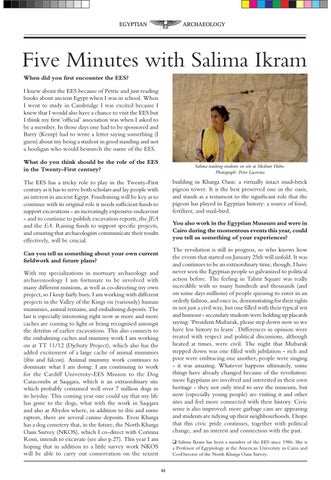
Salima teaching students on site at Medinet Habu. Photograph: Peter Lacovara
building in Kharga Oasis: a virtually intact mud-brick pigeon tower. It is the best preserved one in the oasis, and stands as a testament to the significant role that the pigeon has played in Egyptian history: a source of food, fertilizer, and mail-bird.
The EES has a tricky role to play in the Twenty-First century as it has to serve both scholars and lay people with an interest in ancient Egypt. Fundraising will be key as to continue with its original role it needs sufficient funds to support excavations - an increasingly expensive endeavour - and to continue to publish excavation reports, the JEA and the EA. Raising funds to support specific projects, and ensuring that archaeologists communicate their results effectively, will be crucial.
You also work in the Egyptian Museum and were in Cairo during the momentous events this year, could you tell us something of your experiences? The revolution is still in progress, so who knows how the events that started on January 25th will unfold. It was and continues to be an extraordinary time, though. I have never seen the Egyptian people so galvanized to political action before. The feeling in Tahrir Square was really incredible with so many hundreds and thousands (and on some days millions) of people queuing to enter in an orderly fashion, and once in, demonstrating for their rights in not just a civil way, but one filled with their typical wit and humour - secondary students were holding up placards saying: ‘President Mubarak, please step down now so we have less history to learn’. Differences in opinion were treated with respect and political discussions, although heated at times, were civil. The night that Mubarak stepped down was one filled with jubilation - rich and poor were embracing one another, people were singing - it was amazing. Whatever happens ultimately, some things have already changed because of the revolution: more Egyptians are involved and interested in their own heritage - they not only tried to save the museum, but now (especially young people) are visiting it and other sites and feel more connected with their history. Civic sense is also improved: more garbage cans are appearing and students are tidying up their neighbourhoods. I hope that this civic pride continues, together with political change, and an interest and connection with the past.
Can you tell us something about your own current fieldwork and future plans? With my specializations in mortuary archaeology and archaeozoology I am fortunate to be involved with many different missions, as well as co-directing my own project, so I keep fairly busy. I am working with different projects in the Valley of the Kings on (variously) human mummies, animal remains, and embalming deposits. The last is especially interesting right now as more and more caches are coming to light or being recognised amongst the detritus of earlier excavations. This also connects to the embalming caches and mummy work I am working on at TT 11/12 (Djehuty Project), which also has the added excitement of a large cache of animal mummies (ibis and falcon). Animal mummy work continues to dominate what I am doing: I am continuing to work for the Cardiff University-EES Mission to the Dog Catacombs at Saqqara, which is an extraordinary site which probably contained well over 7 million dogs in its heyday. This coming year one could say that my life has gone to the dogs, what with the work in Saqqara and also at Abydos where, in addition to ibis and some raptors, there are several canine deposits. Even Kharga has a dog cemetery that, in the future, the North Kharga Oasis Survey (NKOS), which I co-direct with Corinna Rossi, intends to excavate (see also p.27). This year I am hoping that in addition to a little survey work NKOS will be able to carry out conservation on the sexiest
q Salima Ikram has been a member of the EES since 1986. She is a Professor of Egyptology at the American University in Cairo and Co-Director of the North Kharga Oasis Survey. 44