EGYPTIAN
ARCHAEOLOGY
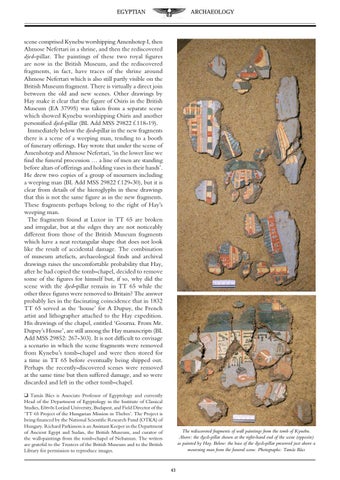
scene comprised Kynebu worshipping Amenhotep I, then Ahmose Nefertari in a shrine, and then the rediscovered djed-pillar. The paintings of these two royal figures are now in the British Museum, and the rediscovered fragments, in fact, have traces of the shrine around Ahmose Nefertari which is also still partly visible on the British Museum fragment. There is virtually a direct join between the old and new scenes. Other drawings by Hay make it clear that the figure of Osiris in the British Museum (EA 37995) was taken from a separate scene which showed Kynebu worshipping Osiris and another personified djed-pillar (BL Add MSS 29822 f.118-19). Immediately below the djed-pillar in the new fragments there is a scene of a weeping man, tending to a booth of funerary offerings. Hay wrote that under the scene of Amenhotep and Ahmose Nefertari, ‘in the lower line we find the funeral procession … a line of men are standing before altars of offerings and holding vases in their hands’. He drew two copies of a group of mourners including a weeping man (BL Add MSS 29822 f.129-30), but it is clear from details of the hieroglyphs in these drawings that this is not the same figure as in the new fragments. These fragments perhaps belong to the right of Hay’s weeping man. The fragments found at Luxor in TT 65 are broken and irregular, but at the edges they are not noticeably different from those of the British Museum fragments which have a neat rectangular shape that does not look like the result of accidental damage. The combination of museum artefacts, archaeological finds and archival drawings raises the uncomfortable probability that Hay, after he had copied the tomb-chapel, decided to remove some of the figures for himself but, if so, why did the scene with the djed-pillar remain in TT 65 while the other three figures were removed to Britain? The answer probably lies in the fascinating coincidence that in 1832 TT 65 served as the ‘house’ for A Dupuy, the French artist and lithographer attached to the Hay expedition. His drawings of the chapel, entitled ‘Gourna. From Mr. Dupuy’s House’, are still among the Hay manuscripts (BL Add MSS 29852: 267-303). It is not difficult to envisage a scenario in which the scene fragments were removed from Kynebu’s tomb-chapel and were then stored for a time in TT 65 before eventually being shipped out. Perhaps the recently-discovered scenes were removed at the same time but then suffered damage, and so were discarded and left in the other tomb-chapel. q Tamás Bács is Associate Professor of Egyptology and currently Head of the Department of Egyptology in the Institute of Classical Studies, Eötvös Loránd University, Budapest, and Field Director of the ‘TT 65 Project of the Hungarian Mission in Thebes’. The Project is being financed by the National Scientific Research Fund (OTKA) of Hungary. Richard Parkinson is an Assistant Keeper in the Department of Ancient Egypt and Sudan, the British Museum, and curator of the wall-paintings from the tomb-chapel of Nebamun. The writers are grateful to the Trustees of the British Museum and to the British Library for permission to reproduce images.
The rediscovered fragments of wall paintings from the tomb of Kynebu. Above: the djed-pillar shown at the right-hand end of the scene (opposite) as painted by Hay. Below: the base of the djed-pillar preserved just above a mourning man from the funeral scene. Photographs: Tamás Bács
43