EGYPTIAN
ARCHAEOLOGY
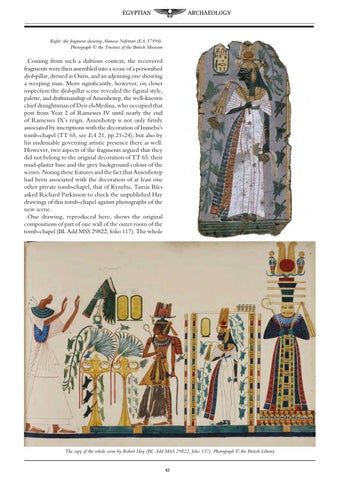
Right: the fragment showing Ahmose Nefertari (EA 37994). Photograph © the Trustees of the British Museum
Coming from such a dubious context, the recovered fragments were then assembled into a scene of a personified djed-pillar, dressed as Osiris, and an adjoining one showing a weeping man. More significantly, however, on closer inspection the djed-pillar scene revealed the figural style, palette, and draftsmanship of Amenhotep, the well-known chief draughtsman of Deir el-Medina, who occupied that post from Year 2 of Ramesses IV until nearly the end of Ramesses IX’s reign. Amenhotep is not only firmly associated by inscriptions with the decoration of Imiseba’s tomb-chapel (TT 65, see EA 21, pp.21-24), but also by his undeniable governing artistic presence there as well. However, two aspects of the fragments argued that they did not belong to the original decoration of TT 65: their mud-plaster base and the grey background colour of the scenes. Noting these features and the fact that Amenhotep had been associated with the decoration of at least one other private tomb-chapel, that of Kynebu, Tamás Bács asked Richard Parkinson to check the unpublished Hay drawings of this tomb-chapel against photographs of the new scene. One drawing, reproduced here, shows the original compositions of part of one wall of the outer room of the tomb-chapel (BL Add MSS 29822, folio 117). The whole
The copy of the whole scene by Robert Hay (BL Add MSS 29822, folio 117). Photograph © the British Library 42