EGYPTIAN
ARCHAEOLOGY
they were associated with objects bearing the royal names of Khakare and Maaibre Sheshi, while the rishi coffins of the ‘accountant of the main enclosure’ Neferhotep and the ‘overseer of the city’ Iuy can be dated by their burial equipment to the Thirteenth Dynasty. Other rishi coffins can be dated stylistically to the late Thirteenth rather than the Seventeenth Dynasty. Following this recent research, the first stage in the spread of rishi coffins seems to follow a ‘bottom-to-top’ development. The adoption of the rishi model by the kings at the end of the Seventeenth Dynasty determined its passage from one of sporadic use to a successful custom, which spread rapidly across society. Indeed, the distribution of the rishi coffin type among private individuals reached its peak only during the first part of the New Kingdom. In conclusion, it appears that the rise of rishi coffins developed from the social and material background of the late Middle Kingdom and that their use during the Second Intermediate Period does not demonstrate a break with previous funerary tradition.
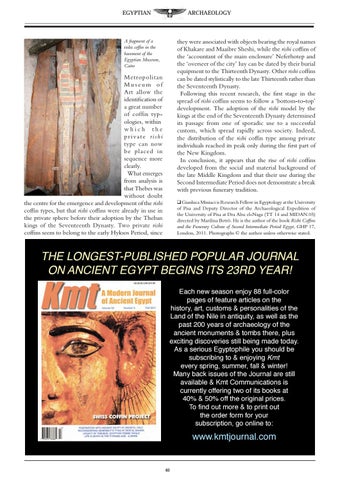
A fragment of a rishi coffin in the basement of the Egyptian Museum, Cairo
Metropolitan Museum of Art allow the identification of a great number of coffin typologies, within 8 8 8 2*7.58!88 ! !!88! 8 88 2(68! which the private rishi type can now be placed in sequence more clearly. What emerges from analysis is that Thebes was without doubt the centre for the emergence and development of the rishi coffin types, but that rishi coffins were already in use in the private sphere before their adoption by the Theban kings of the Seventeenth Dynasty. Two private rishi coffins seem to belong to the early Hyksos Period, since
q Gianluca Miniaci is Research Fellow in Egyptology at the University of Pisa and Deputy Director of the Archaeological Expedition of the University of Pisa at Dra Abu el-Naga (TT 14 and MIDAN.05) directed by Marilina Betrò. He is the author of the book Rishi Coffins and the Funerary Culture of Second Intermediate Period Egypt, GHP 17, London, 2011. Photographs Š the author unless otherwise stated.
2,+806#8462470860 7*8 8-.// ,7/71 '2(6487-8-625.1682153,/6487085+68 +34571*%8215%8,.457)48"8'614702/3536487-85+6 20$87-85+68 3/683082053 .35*%8248#6//82485+6 '2458 8*621487-821,+267/7(*87-85+68 20,36058)70.)60548"857)&485+616%8'/.48 6 ,3530(8$34,7 613648453//8&630(8)2$6857$2* 482846137.48 (*'57'+3/68*7.84+7./$8&68 4.&4,13&30(8578"860 7*30(8 6 61*84'130(%84.))61%8-2//8"8#30561 8 20*8&2, 8344.6487-85+68 7.102/82168453// 2 23/2&/68"8 )58 7)).03,2537048348 ,.11605/*87--6130(85#787-83548&77 48258 8"8 87--85+68713(302/8'13,64 8 78-30$87.58)7168"8578'130587.58 5+6871$618-71)8-718*7.18 4.&4,13'5370%8(7870/306857
### )5 7.102/ ,7) 40