EGYPTIAN
ARCHAEOLOGY
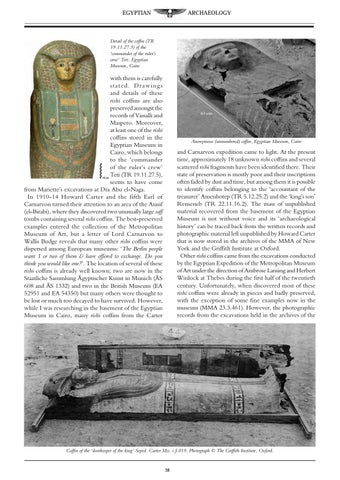
Detail of the coffin (TR 19.11.27.5) of the ‘commander of the ruler’s crew’ Teti. Egyptian Museum, Cairo
with them is carefully stated. Drawings and details of these rishi coffins are also preserved amongst the records of Vassalli and Maspero. Moreover, at least one of the rishi coffins stored in the Egyptian Museum in Cairo, which belongs to the ‘commander of the ruler’s crew’ Teti (TR 19.11.27.5), seems to have come from Mariette’s excavations at Dra Abu el-Naga. In 1910-14 Howard Carter and the fifth Earl of Carnarvon turned their attention to an area of the Asasif (el-Birabi), where they discovered two unusually large saff tombs containing several rishi coffins. The best-preserved examples entered the collection of the Metropolitan Museum of Art, but a letter of Lord Carnarvon to Wallis Budge reveals that many other rishi coffins were dispersed among European museums: ‘The Berlin people want 1 or two of them & have offered to exchange. Do you think you would like one?’. The location of several of these rishi coffins is already well known; two are now in the Staatliche Sammlung Ägyptischer Kunst in Munich (ÄS 608 and ÄS 1332) and two in the British Museum (EA 52951 and EA 54350) but many others were thought to be lost or much too decayed to have survived. However, while I was researching in the basement of the Egyptian Museum in Cairo, many rishi coffins from the Carter
Anonymous (unnumbered) coffin, Egyptian Museum, Cairo
and Carnarvon expedition came to light. At the present time, approximately 18 unknown rishi coffins and several scattered rishi fragments have been identified there. Their state of preservation is mostly poor and their inscriptions often faded by dust and time, but among them it is possible to identify coffins belonging to the ‘accountant of the treasurer’ Amenhotep (TR 5.12.25.2) and the ‘king’s son’ Renseneb (TR 22.11.16.2). The mass of unpublished material recovered from the basement of the Egyptian Museum is not without voice and its ‘archaeological history’ can be traced back from the written records and photographic material left unpublished by Howard Carter that is now stored in the archives of the MMA of New York and the Griffith Institute at Oxford. Other rishi coffins came from the excavations conducted by the Egyptian Expedition of the Metropolitan Museum of Art under the direction of Ambrose Lansing and Herbert Winlock at Thebes during the first half of the twentieth century. Unfortunately, when discovered most of these rishi coffins were already in pieces and badly preserved, with the exception of some fine examples now in the museum (MMA 23.3.461). However, the photographic records from the excavations held in the archives of the
Coffin of the ‘doorkeeper of the king’ Seped. Carter Mss. i.J.019. Photograph © The Griffith Institute, Oxford. 38