EGYPTIAN
ARCHAEOLOGY
Re-excavating rishi coffins in museums and archives Recent study of unpublished rishi coffins provides new insights into the funerary culture of Second Intermediate Period Egypt and permits an exploration of the mechanisms of social transformation and cultural transmission. Gianluca Miniaci describes his excavations in archives and museums. During the late Middle Kingdom and Second Intermediate Period rectangular coffins were gradually falling into disuse and giving way to a distinctive type of anthropoid coffin with feathered decoration, now known as rishi from the Arabic word for ‘feathered’. This type of coffin is commonly decorated with a pair of mirroring wings which cover the lid from shoulder to foot, while the head usually features a royal nemesheaddress. In most of the examples, the chest of the coffin is decorated with a broad wesekh-collar, a vulture with outstretched wings and a rearing cobra. A vertical column usually divides the torso of the coffin into two parts and, in some cases, is inscribed with a standard offering formula and the name and titles of the deceased. Their workmanship is generally mediocre, and usually they are made of low-quality timber, often sycamore fig or some other native tree species. The ideology that lies behind the feathered pattern has been much debated among scholars, but as yet no argument seems to be conclusive. The feathers could represent the ba of the deceased or the bas of Re and Osiris while merging together in the form of a bird, as related in the myth of Osiris’ rebirth, but other possible hypotheses have been advanced. The importance of rishi coffins is due to their appearance and spread within a period of intense social and cultural change - the Second Intermediate Period. Therefore, a detailed analysis of the rise and the fall of the rishi coffin type can reveal new social and cultural patterns in burial customs and ritual traditions of that period. For a long time, the rishi coffins referred to in Egyptological literature were relatively few in number. These include the royal coffins of Sekhemre Heruhirmaat Intef (Louvre, E.3020), Sekhemre Wepmaat Intef (Louvre, E.3019), Nubkheperre Intef (British Museum, EA 6652), Seqenenre Djehuty-aa (Cairo Museum, CG 61001), Kamose (Cairo Museum, TR 14.12.27.12), Ahhotep (Cairo Museum, JE 28501) and the so-called ‘Qurna Queen’ (National Museums Scotland, A.1909.527.1, see also p.36), plus a certain number of private examples lacking any specific chronological information. This limited selection led Egyptologists to date the first use of rishi coffins to the Seventeenth Dynasty, based on the examples for kings assigned to that time, and to consider
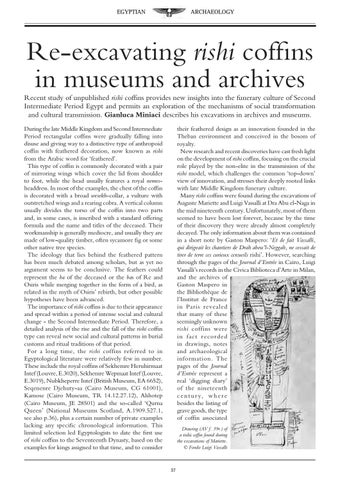
their feathered design as an innovation founded in the Theban environment and conceived in the bosom of royalty. New research and recent discoveries have cast fresh light on the development of rishi coffins, focusing on the crucial role played by the non-elite in the transmission of the rishi model, which challenges the common ‘top-down’ view of innovation, and stresses their deeply rooted links with late Middle Kingdom funerary culture. Many rishi coffins were found during the excavations of Auguste Mariette and Luigi Vassalli at Dra Abu el-Naga in the mid nineteenth century. Unfortunately, most of them seemed to have been lost forever, because by the time of their discovery they were already almost completely decayed. The only information about them was contained in a short note by Gaston Maspero: ‘Et de fait Vassalli, qui dirigeait les chantiers de Drah abou’l-Neggah, ne cessait de tirer de terre ces curieux cercueils rishi’. However, searching through the pages of the Journal d’Entrée in Cairo, Luigi Vassalli’s records in the Civica Biblioteca d’Arte in Milan, and the archives of Gaston Maspero in the Bibliothèque de l’Institut de France in Paris revealed that many of these seemingly unknown rishi coffins were in fact recor ded in drawings, notes and archaeological information. The pages of the Journal d’Entrée represent a real ‘digging diary’ of the nineteenth c e n t u r y, w h e r e besides the listing of grave goods, the type of coffin associated Drawing (AV f. 39r ) of a rishi coffin found during the excavations of Mariette. © Fondo Luigi Vassalli
37