EGYPTIAN
ARCHAEOLOGY
ACCES-ing Egyptian and Sudanese collections in the UK
The work of the Association for Curators of Collections from Egypt and Sudan (ACCES), sharing knowledge and expertise, is described by Campbell Price and Gina Criscenzo-Laycock. receive feedback and suggestions for future activities. ACCES is particularly keen to highlight the existence of archive material, and to encourage its use by members. Recent initiatives have raised awareness among nonspecialist curators of major Egyptological archives at the EES, Petrie Museum, Griffith Institute and Garstang Museum, Liverpool. ACCES also continues to encourage archival research in smaller collections as this can be an especially useful resource for presenting narratives about the acquisition of objects by local figures, which is of interest to regional audiences. A recent priority was to raise the profile of ACCES among its own members and more broadly, and Facebook proved a useful platform to post news, share images and discuss topics of mutual interest. Redevelopment of the ACCES website included uploading more information on individual collections and resources, links to Facebook galleries of collection highlights, and a search function linked to the CultureGrid (formerly Cornucopia) website, enabling searches (by object type, site, or excavator) of all ACCES members. It is hoped that the ACCES website will act as a hub for information about Egyptian and Sudanese collections in the UK, and provide a valuable means of increasing their visibility among Egyptologists and non-specialists alike.
ACCES was founded in May 2006 as a Subject Specialist Network (SSN) for museum curators throughout the United Kingdom responsible for archaeological collections from Egypt and Sudan. The SSN scheme is an initiative to share knowledge and expertise within certain subject areas, funded by the Museums, Libraries and Archives Council (MLA - www.mla.gov.uk). The main aim of ACCES is to facilitate the exchange of information and good practice between 15 core museums with large Egyptian and Sudanese collections, some 200 smaller collections elsewhere in the UK, and a broader academic and public audience. The task of quantifying the number and extent of provincial collections in the UK was initiated by the British Museum and subsequently more detailed research based on this data was led by Margaret Serpico of the Petrie Museum. A full survey revealed that over 200 UK institutions (now members of the ACCES network) hold more than 375,000 objects from Egypt and Sudan. In the last year, ACCES has organised a series of practical workshops for non-specialist curators, with topics designed to cover issues encountered by local museums when researching their collections. Members from core institutions gave presentations on ‘Distribution Lists’ (hosted by the EES in London), ‘Object Marks’ (at the Garstang Museum, University of Liverpool), and ‘Identifying Fakes’ (at Norwich Castle Museum). The workshops provided an informal setting for dialogue between curators, and an opportunity for ACCES to
q Campbell Price and Gina Criscenzo-Laycock were ACCES Project Assistants 2010-11. Photograph by Oliver Smith, courtesy of Manchester Museums. For more on ACCES, reports on workshops and information on collections, visit the website: www.acces.org.uk
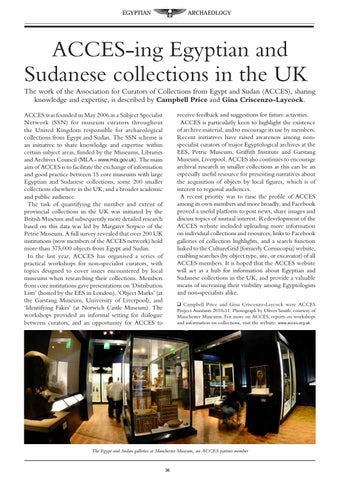
The Egypt and Sudan galleries at Manchester Museum, an ACCES partner member 36