EGYPTIAN
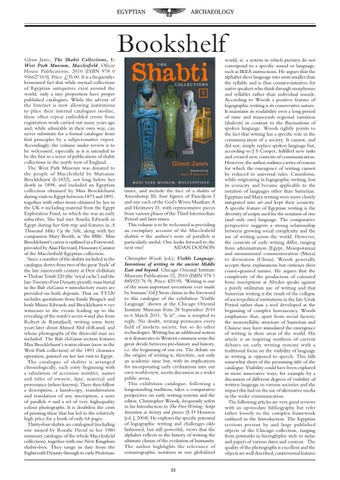
Glenn Janes, The Shabti Collections, 1: West Park Museum, Macclesfield. Olicar House Publications, 2010 (ISBN 978 0 95662710 0). Price: £35.00. It is a frequentlybemoaned fact that while myriad collections of Egyptian antiquities exist around the world, only a tiny proportion have proper published catalogues. While the advent of the Internet is now allowing institutions to place their internal catalogues on-line, these often repeat embedded errors from registration work carried out many years ago and, while admirable in their own way, can never substitute for a formal catalogue from first principles by a subject-matter expert. Accordingly, the volume under review is to be welcomed, especially as it is intended to be the first in a series of publications of shabti collections in the north west of England. The West Park Museum was donated to the people of Macclesfield by Marianne Brocklehurst (b.1832), not long before her death in 1898, and included an Egyptian collection obtained by Miss Brocklehurst during visits to Egypt between 1873 and 1891, together with other items obtained by her in the UK – including material from the Egypt Exploration Fund, to which she was an early subscriber. She had met Amelia Edwards in Egypt during her first trip and features in A Thousand Miles Up the Nile, along with her companion Mary Booth, as ‘the MBs’. Miss Brocklehurst’s career is outlined in a Foreword, provided by Alan Hayward, Honorary Curator of the Macclesfield Egyptian collection. Since a number of the shabtis included in the catalogue derive from two of the great ‘finds’ of the late nineteenth century at Deir el-Bahari – Theban Tomb 320 (the ‘royal cache’) and the late Twenty-First Dynasty priestly mass burial in the Bab el-Gasus – introductory essays are provided on both deposits. That on TT320 includes quotations from Emile Brugsch and both Misses Edwards and Brocklehurst – eye witnesses to the events leading up to the revealing of the tomb’s secret – and also from Robert de Rustafjaell, writing some forty years later about Ahmed Abd el-Rassul, and whose photographs of the then-old man are included. The Bab el-Gasus section features Miss Brocklehurst’s watercolours (now in the West Park collection) of the 1891 clearance operation, painted on her last visit to Egypt. The catalogue of shabtis is arranged chronologically, each entry beginning with a tabulation of accession number, names and titles of owners, date, material and provenance (where known). There then follow a description, a hand-copy, transliteration and translation of any inscription, a note of parallels – and a set of very high-quality colour photographs. It is doubtless the costs of printing these that has led to the relatively high price for a book of only 64 pages. Thirty-four shabtis are catalogued (including one missed by Rosalie David in her 1980 summary catalogue of the whole Macclesfield collection), together with one New Kingdom shabti-box. They range in date from the Eighteenth Dynasty through to early Ptolemaic
ARCHAEOLOGY
Bookshelf
times, and include the face of a shabti of Amenhotep III, four figures of Panedjem I and one each of the God’s Wives Maatkare A and Henttawy D, with representative pieces from various phases of the Third Intermediate Period and later times. This volume is to be welcomed as providing an exemplary account of the Macclesfield shabtis – the author’s note of parallels is particularly useful. One looks forward to the next one! AIDAN DODSON Christopher Woods (ed.), Visible Language. Inventions of writing in the ancient Middle East and beyond. Chicago Oriental Institute Museum Publications 32, 2010 (ISBN 978 1 885923 76 9). Price: $29.95. ‘Writing is one of the most important inventions ever made by humans’ Gil J Stein claims in the foreword to this catalogue of the exhibition ‘Visible Language’ shown at the Chicago Oriental Institute Museum from 28 September 2010 to 6 March 2011. ‘Is it?’, one is tempted to reply. No doubt, writing permeates every field of modern society, but so do other technologies. Writing has an additional notion as it demarcates in Western common sense the great divide between pre-history and history, i.e. the beginning of our era. The debate on the origins of writing is, therefore, not only an academic issue but, with its implications for incorporating early civilizations into our own world-view, merits discussion in a wider public arena. This exhibition catalogue, following a long-standing tradition, takes a comparative perspective on early writing systems and the editor, Christopher Woods, frequently refers in his Introduction to The First Writing: Script Invention as history and process (S D Houston [ed. ], 2004). He explores the specific potential of logographic writing and challenges oldfashioned, but still powerful, views that the alphabet reflects in the history of writing the ultimate climax of the evolution of humanity. The author highlights the relevance of semasiographic notation in our globalized 33
world, ie. a system in which pictures do not correspond to a specific sound or language, such as IKEA instructions. He argues that the alphabet slices language into units smaller than the syllable and is thus counter-intuitive for native speakers who think through morphemes and syllables rather than individual sounds. According to Woods a positive feature of logographic writing is its conservative nature. It maintains its readability over a long period of time and transcends regional variation (dialects) in contrast to the fluctuations of spoken language. Woods rightly points to the fact that writing has a specific role in the communication of a society. It cannot, and did not, simply replace spoken language but, according to J S Cooper, fulfilled new tasks and created new contexts of communication. However, the author outlines a series of reasons for which the emergence of writing cannot be reduced to universal rules. Cuneiform, while originating in logographic writing, lost its iconicity and became applicable to the notation of languages other than Sumerian. Egyptian and Maya writing were more closely integrated into art and kept their iconicity. A specific feature of Egyptian writing is the diversity of scripts used for the notation of one (and only one) language. The comparative perspective suggests a strong relationship between growing social complexity and the use of writing across the world. However, the contexts of early writing differ, ranging from administration (Egypt, Mesopotamia) and monumental commemoration (Maya) to divination (China). Woods generally accepts these explanations but criticises their coarse-grained nature. He argues that the complexity of the production of coloured bone inscriptions at Abydos speaks against a purely utilitarian use of writing and that Sumerian writing is the result of the collapse of socio-political institutions in the late Uruk Period rather than a tool developed at the beginning of complex bureaucracy. Woods emphasises that, apart from social factors, the monosyllabic structure of Sumerian and Chinese may have stimulated the emergence of writing in these areas of the world. His article is an inspiring synthesis of current debates on early writing systems with a traditional focus on the visibility of language in writing as opposed to speech. This falls somewhat short of the promising title of the catalogue. Visibility could have been explored in more innovative ways, for example by a discussion of different degrees of visibility of written language in various societies and the impact this had on the use of alternative media in the wider communication. The following articles are very good reviews with an up-to-date bibliography but refer rather loosely to the complex framework outlined in the Introduction. The Egyptian sections present by and large published objects of the Chicago collection, ranging from potmarks in hieroglyphic style to stelae and papyri of various dates and content. The quality of the photographs is excellent and the objects are well described, controversial features