EGYPTIAN
ARCHAEOLOGY
Raising one of the black granite blocks of the statue pedestals
Pedestal blocks outside the storage magazine
Hatnub quarries in Middle Egypt. This material is rarely used for colossal statuary and these colossi are the tallest known of Hatnub alabaster, with an estimated height of c.18m. They collapsed during a severe earthquake in the New Kingdom and were broken into several large pieces, which were only partly visible in an alluvial layer of Nile mud. All these pieces will gradually be uncovered for conservation and reassembly next season, to be restored to their original place in the near future. Along with the alabaster pieces of the colossal statues we also recovered two large blocks and several smaller pieces in black granite which belong to the pedestals of the colossi. These blocks are decorated with personifications of foreign lands and in size and decoration are parallelled by similar blocks found reused in a structure at Karnak South. In 2006 we moved these to the funerary temple of Amenhotep III, on the assumption that they might belong to alabaster colossi there as they have an inscription mentioning ‘alabaster from Hatnub’ - a decision which is now fully justified. The newly-discovered granite blocks will be added to those brought from Karnak to restore the pedestals of the reconstructed alabaster colossi. During the 2011 season we also investigated, through excavations, research, documentation and conservation,
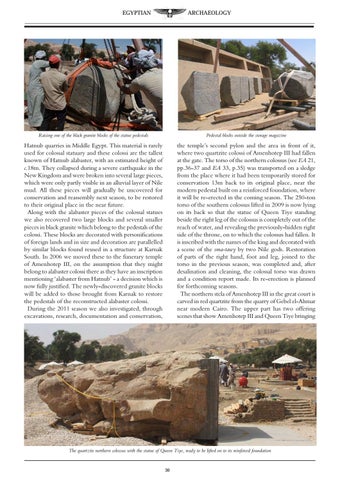
the temple’s second pylon and the area in front of it, where two quartzite colossi of Amenhotep III had fallen at the gate. The torso of the northern colossus (see EA 21, pp.36-37 and EA 33, p.35) was transported on a sledge from the place where it had been temporarily stored for conservation 13m back to its original place, near the modern pedestal built on a reinforced foundation, where it will be re-erected in the coming season. The 250-ton torso of the southern colossus lifted in 2009 is now lying on its back so that the statue of Queen Tiye standing beside the right leg of the colossus is completely out of the reach of water, and revealing the previously-hidden right side of the throne, on to which the colossus had fallen. It is inscribed with the names of the king and decorated with a scene of the sma-tawy by two Nile gods. Restoration of parts of the right hand, foot and leg, joined to the torso in the previous season, was completed and, after desalination and cleaning, the colossal torso was drawn and a condition report made. Its re-erection is planned for forthcoming seasons. The northern stela of Amenhotep III in the great court is carved in red quartzite from the quarry of Gebel el-Ahmar near modern Cairo. The upper part has two offering scenes that show Amenhotep III and Queen Tiye bringing
The quartzite northern colossus with the statue of Queen Tiye, ready to be lifted on to its reinforced foundation 30