EGYPTIAN
ARCHAEOLOGY
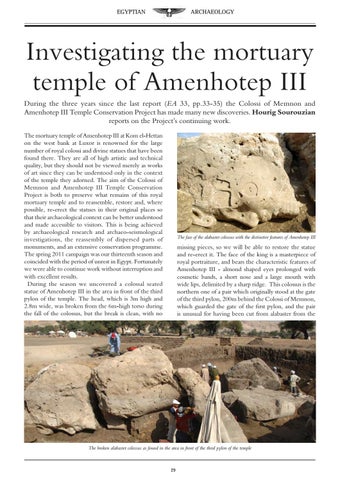
Investigating the mortuary temple of Amenhotep III During the three years since the last report (EA 33, pp.33-35) the Colossi of Memnon and Amenhotep III Temple Conservation Project has made many new discoveries. Hourig Sourouzian reports on the Project’s continuing work. The mortuary temple of Amenhotep III at Kom el-Hettan on the west bank at Luxor is renowned for the large number of royal colossi and divine statues that have been found there. They are all of high artistic and technical quality, but they should not be viewed merely as works of art since they can be understood only in the context of the temple they adorned. The aim of the Colossi of Memnon and Amenhotep III Temple Conservation Project is both to preserve what remains of this royal mortuary temple and to reassemble, restore and, where possible, re-erect the statues in their original places so that their archaeological context can be better understood and made accessible to visitors. This is being achieved by archaeological research and archaeo-seismological investigations, the reassembly of dispersed parts of monuments, and an extensive conservation programme. The spring 2011 campaign was our thirteenth season and coincided with the period of unrest in Egypt. Fortunately we were able to continue work without interruption and with excellent results. During the season we uncovered a colossal seated statue of Amenhotep III in the area in front of the third pylon of the temple. The head, which is 3m high and 2.8m wide, was broken from the 6m-high torso during the fall of the colossus, but the break is clean, with no
The face of the alabaster colossus with the distinctive features of Amenhotep III
missing pieces, so we will be able to restore the statue and re-erect it. The face of the king is a masterpiece of royal portraiture, and bears the characteristic features of Amenhotep III - almond shaped eyes prolonged with cosmetic bands, a short nose and a large mouth with wide lips, delimited by a sharp ridge. This colossus is the northern one of a pair which originally stood at the gate of the third pylon, 200m behind the Colossi of Memnon, which guarded the gate of the first pylon, and the pair is unusual for having been cut from alabaster from the
The broken alabaster colossus as found in the area in front of the third pylon of the temple
29