EGYPTIAN
ARCHAEOLOGY
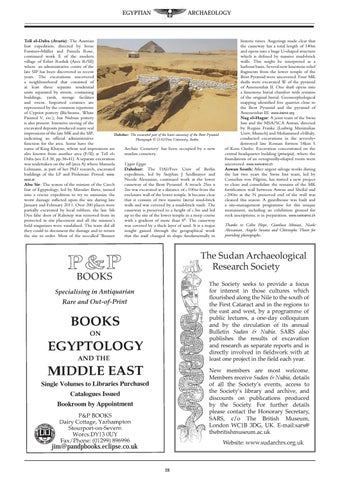
Tell el-Daba (Avaris): The Austrian Inst expedition, directed by Irene Forstner-Müller and Pamela Rose, continued work E of the modern village of Ezbet Rushdi (Area R/III) where an administrative centre of the late SIP has been discovered in recent years. The excavations uncovered a neighbourhood that consisted of at least three separate residential units separated by streets, containing buildings, yards, storage facilities and ovens. Imported ceramics are represented by the common repertoire of Cypriot pottery (Bichrome, White Painted V, etc.), but Nubian pottery is also present. Intensive sieving of the excavated deposits produced many seal impressions of the late MK and the SIP, Dahshur: The excavated part of the lower causeway of the Bent Pyramid. indicating an official administrative Photograph © DAI/Free University, Berlin function for the area. Some have the Archaic Cemetery’ has been occupied by a new name of King Khayan, whose seal impressions are muslim cemetery. also known from another area (F/II) at Tell elDaba (see EA 38, pp.38-41). A separate excavation Upper Egypt was undertaken on the tell (area A) where Manuela Dahshur: The DAI/Free Univ of Berlin Lehmann, as part of her PhD research, excavated expedition, led by Stephan J Seidlmayer and buildings of the LP and Ptolemaic Period. www. Nicole Alexanian, continued work at the lower oeai.at causeway of the Bent Pyramid. A trench 25m x Abu Sir: The season of the mission of the Czech 2m was excavated at a distance of c.100m from the Inst of Egyptology, led by Miroslav Barta, turned enclosure wall of the lower temple. It became clear into a rescue expedition to try to minimize the that it consists of two massive lateral mud-brick worst damage inflicted upon the site during late walls and was covered by a mud-brick vault. The January and February 2011. Over 200 places were causeway is preserved to a height of c.3m and led partially excavated by local robbers, the late 5th up to the site of the lower temple in a steep course Dyn false door of Rahotep was removed from its with a gradient of more than 8°. The causeway protected in situ placement and all the mission’s was covered by a thick layer of sand. It is a major field magazines were vandalised. The team did all insight gained through the geographical work they could to document the damage and to return that the wadi changed its shape fundamentally in the site to order. Most of the so-called ‘Bonnet
historic times. Augerings made clear that the causeway has a total length of 140m and opens into a huge U-shaped structure which is defined by massive mud-brick walls. This might be interpreted as a harbour basin. Several new limestone relief fragments from the lower temple of the Bent Pyramid were uncovered. Four MK shafts were excavated W of the pyramid of Amenemhat II. One shaft opens into a limestone burial chamber with remains of the original burial. Geomorphological mapping identified five quarries close to the Bent Pyramid and the pyramid of Amenemhat III. www.dainst.org Nag el-Hagar: A joint team of the Swiss Inst and the MSA/SCA Aswan, directed by Regina Franke (Ludwig Maximilian Univ, Munich) and Mohammed el-Bialy, conducted excavations in the severelydestroyed late Roman fortress 18km S of Kom Ombo. Excavation concentrated on the central headquarter building (principia), where the foundations of an octogonally-shaped room were uncovered. www.swissinst.ch Aswan South: After urgent salvage works during the last two years the Swiss Inst team, led by Cornelius von Pilgrim, has started a new project to clean and consolidate the remains of the MK fortification wall between Aswan and Shellal and c.200m at the N preserved end of the wall was cleaned this season. A guardhouse was built and a site-management programme for this unique monument, including an exhibition ground for rock inscriptions, is in preparation. www.swissinst.ch Thanks to Colin Hope, Gianluca Miniaci, Nicole Alexanian, Angelo Sesana and Christophe Thiers for providing photographs.
The Sudan Archaeological Research Society The Society seeks to provide a focus for interest in those cultures which flourished along the Nile to the south of the First Cataract and in the regions to the east and west, by a programme of public lectures, a one-day colloquium and by the circulation of its annual Bulletin Sudan & Nubia. SARS also publishes the results of excavation and research as separate reports and is directly involved in fieldwork with at least one project in the field each year. New members are most welcome. Members receive Sudan & Nubia, details of all the Society’s events, access to the Society’s library and archive, and discounts on publications produced by the Society. For further details please contact the Honorary Secretary, SARS, c/o The British Museum, London WC1B 3DG, UK. E-mail:sars@ thebritishmuseum.ac.uk Website: www.sudarchrs.org.uk
jim@pandpbooks.eclipse.co.uk 28