EGYPTIAN
Hagr Edfu: Despite an interruption to the season, the BM team, directed by Vivian Davies with Elisabeth O’Connell as co-Director, made substantial progress. Rock inscriptions located on the site’s hill-top ‘rock-shelter’ and dating from as early as the OK to Late Antiquity, were collated and planned. Coptic dipinti in a rock-cut tomb reused for habitation in Late Antiquity were copied and/or collated. More Coptic ostraca from the site (now in the SCA magazine at Elkab) were located. The topographic map, a surface pottery survey and epigraphic work on the site’s most important pharaonic tombs are nearing completion. Hierakonpolis: The BM expedition, directed by Renée Friedman, was able, with the support of the Edfu/Aswan SCA Inspectorate, to continue work throughout the revolution. Excavations of the Predynastic brewery installation at HK24B were resumed by Izumi Takamiya (Kinki Univ, Japan). The full plan of the structure with its 16 vat emplacements was uncovered and a circular mudbrick granary near by was investigated. Continued excavations at the wadi site HK11C by Masahiro Baba (Waseda Univ, Japan) revealed walls built of hand-formed mud bricks in association with pottery-making tools. This may be the earliest in situ mud-brick architecture in Upper Egypt. Excavations continued at HK6, the elite Predynastic cemetery, to determine the extent of the tomb complex around the large Tomb 16, presumed to belong to a Naqada Ic-IIa ruler of Hierakonpolis. Five new tombs (45-50) were discovered and include the burials of a crocodile, a pregnant hartebeest, a large male leopard, 10 dogs, many cattle and three humans, one of whom was a male dwarf. The wooden funerary chapel for Tomb 16 was uncovered along with two new flint figurines, one in the shape of a human and the other a donkey; both are unique. www.hierakonpolisonline.org
Kom Ombo-Aswan region: The Yale Univ/ Univ of Bologna team, led by Maria Gatto and Alberto Curci, continued the rescue excavation of the Predynastic cemetery at Nag el-Qarmila (Kubbaniya). The team also continued the geomorphological survey in Gharb Aswan and Nag el-Qarmila and digital documentation of the rock art in Wadi Abu Subeira. Epigraphic and digital documentation of the Dynasty 0 rock art site in Nag el-Hamdulab was completed. Nag el-Tawil: An Austrian Inst/Swiss Inst project, directed by Martin Steksal, was started aiming to investigate archaeologically this site c.20km N of Aswan. A complete architectural survey of the well-preserved Roman quay walls on the banks of the Nile, already described by Horst Jaritz in 1972, was carried out. www.oeai.at Aswan (Syene): The joint team of the Swiss Inst and the MSA/SCA Aswan, headed by Cornelius von Pilgrim and Mohammed el-Bialy, and directed in the field by Wolfgang Müller, prepared the construction site for a magazine and office building for the mission. Fieldwork focused on final investigations in Birket Damas (Area 2). Beneath high accumulations (Ptolemaic–Late Roman) outside the LP town wall a well-preserved mastaba tomb of the late 6th Dyn with four burial chambers was discovered. Beyond the town wall remains of Roman houses were cleaned and recorded. After the demolition of a house in Old Aswan, over 100 fragments of decorated temple blocks were collected; some can be attributed to the so-called Temple X from Elephantine. www. swissinst.ch
Dakhla Oasis: 1. The Monash Univ team, led by Gillian Bowen, worked at Deir Abu Metta in five areas: the nave of the church, the area outside the church wall in the NE, the tower, the central W building and the passageway between the latter and the church. Two earlier building phases were detected beneath the
ARCHAEOLOGY
church extending beyond its N wall; their function has not been determined but there is no evidence to indicate that they are of an ecclesiastical nature. A test cut in the passageway between the church and the W building confirms that the two structures were contemporary. Evidence was found for late domestic activity in the tower’s corridor; several Coptic ostraca (late fourth-fifth centuries) retrieved from this context refer to Christian fathers. Intrusive graves were found in the SE rooms of the W building and further graves were found N of the church, indicating that after the abandonment of the buildings the area became a Christian cemetery. www.arts.monash. edu.au/archaeology/
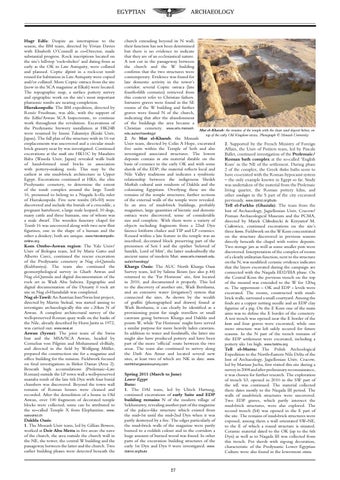
Mut el-Kharab: the remains of the temple with the clean sand deposit below, on top of the early Old Kingdom strata. Photograph © Monash University
2. At Mut el-Kharab, the Monash Univ team, directed by Colin A Hope, excavated five units within the Temple of Seth and also investigated associated structures. The lowest deposits contain in situ material datable on the basis of ceramics to the early OK and with some sherds of the EDP; the material reflects local and Nile Valley traditions and indicates a symbiotic relationship between the indigenous Sheikh Muftah cultural unit residents of Dakhla and the colonizing Egyptians. Overlying these are the remains of the temple structures; further sections of the external walls of the temple were revealed. In an area of mud-brick buildings, probably magazines, large quantities of hieratic and demotic ostraca were discovered, some of considerable size and complete. With them were a variety of objects including fragments from a 22nd Dyn faience lotiform chalice and TIP and LP ceramics. Reused within a late feature in the temple was an inscribed, decorated block preserving part of the prenomen of Seti I and the epithet ‘beloved of Sutekh, Lord of Mitt’, the latter undoubtedly the ancient name of modern Mut. www.arts.monash.edu. au/archaeology/
Kharga Oasis: The AUC North Kharga Oasis Survey team, led by Salima Ikram (see also p.44) returned to the ‘Far Horizons’ site, first located in 2010, and documented it properly. This led to the discovery of another site, Wadi Bershama, and an extensive water (irrigation?) system that connected the sites. As shown by the wealth of graffiti (photographed and drawn) found at Wadi Bershama, it can clearly be identified as a provisioning point for single travellers or small caravans going between Kharga and Dakhla and points W, while ‘Far Horizons’ might have served a similar purpose for more heavily laden caravans. In addition to water and foodstuffs, the latter site might also have produced pottery and have been part of the more ‘official’ route between the two areas. The team also continued to survey along the Darb Ain Amur and located several new sites, at least two of which are NK in date. www. northkhargaoasissurvey.com
Spring 2011 (March to June) Lower Egypt Buto: 1. The DAI team, led by Ulrich Hartung, continued excavations of early Saite and EDP building remains N of the modern village of Sekhemawy, revealing another part of the magazine of the palace-like structure which existed from the mid-1st until the mid-2nd Dyn when it was partly destroyed by a fire. The edges particularly of the mud-brick walls of the magazine were partly burned to a reddish colour and in the corridors a huge amount of burned wood was found. In other parts of the excavation building structures of the early 1st Dyn and Dyn 0 were investigated. www. dainst.org/buto
27
2. Supported by the French Ministry of Foreign Affairs, the Univ of Poitiers team, led by Pascale Ballet, continued investigation of the Ptolemaic/ Roman bath complex at the so-called ‘English Kom’ in the NE of the settlement. During phase 2 of the complex, the Greek tholos baths seem to have co-existed with the Roman hypocaust system – the only example known in Egypt so far. Study was undertaken of the material from the Ptolemaic living quarter, the Roman pottery kilns, and other sondages in the S part of the city excavated previously. www.dainst.org/buto Tell el-Farkha (Ghazala): The team from the Inst of Archaeology, Jagiellonian Univ, Cracow/ Poznan Archaeological Museum and the PCMA, directed by Marek Chłodnicki & Krzysztof M. Ciałowicz, continued excavations on the site’s three koms. Fieldwork on the W Kom concentrated on the structure discovered in previous seasons directly beneath the chapel with votive deposits. Two storage jars as well as some smaller pots were discovered. Interpretation of the complex of rooms of a clearly utilitarian function, next to the structure on the N, was modified: ceramic evidence indicates that the layers excavated during the campaign are connected with the Naqada IID2/IIIA phase. On the Central Kom the previous trench on the top of the mound was extended to the W for 120sq m. The uppermost – OK and EDP - levels were excavated. The rooms, constructed with mudbrick walls, surround a small courtyard. Among the finds are a copper netting needle and an EDP clay figurine of a pig. On the E Kom one of the main aims was to define the E border of the cemetery. A test trench was opened near the E border of the kom and four graves were excavated, while one more structure was left safely secured for future seasons. In the N part of the trench remains of the EDP settlement were excavated, including a pottery silo 1m high. www.farkha.org Tell el-Murra: The Polish Archeological Expedition to the North-Eastern Nile Delta of the Inst of Archaeology, Jagiellonian Univ, Cracow, led by Mariusz Jucha, first visited this site during a survey in 2008 and after preliminary reconnaissance, it was chosen for further research. The exploration of trench S3, opened in 2010 in the SW part of the tell, was continued. The material collected there dates mostly to the Naqada III period. The walls of mud-brick structures were uncovered. Two EDP graves, which partly intersect the mud-brick structures, were also explored. The second trench (S4) was opened in the E part of the site. The remains of mud-brick structures were exposed, among them a wall orientated SW-NE, to the E of which a round structure is situated. Ceramic material dated to the OK (up to the 6th Dyn) as well as to Naqada III was collected from this trench. Pot sherds with zig-zag decoration, characteristic of the Predynastic Lower Egyptian Culture were also found in the lowermost strata.