EGYPTIAN
ARCHAEOLOGY
recognised in both. Excavation in MIDAN.05 focused also on the N part of the transverse hall, where the remains of painted scenes were brought to light on the E wall. WINTER 2010-11 (November to March) Lower Egypt Giza: The AERA team led by Mark Lehner, Mohsen Kamel and Ana Tavares worked at the Heit el-Ghurab (HeG, near the Wall of the Crow) site, focusing on the initial identification and excavation of a structure which was probably used as a cattle corral and slaughterhouse. This structure was built of large walls with rounded corners and had a narrow, chute-like passage, and a broad open area approximately 37m x 30m. It was capable of holding an estimated 555 cattle at a time. Excavation also continued in select areas of House Unit 1, W of the modern soccer field. Excavations in the Khentkawes Town have shown that the queen’s foundation extends far beyond the monument and settlement as excavated by Selim Hassan. Work in 2010 added 50m to the E with approach-ramps, stairs, and terrace, as well as a large basin and E continuation of a large enclosure wall. This season’s newly discovered silo building and court adds a further 15-20m of settlement to this continuing eastward expansion. Excavations at the Menkaure Valley Temple sought to clarify the relationship between the ante-town (Annexe) and the Temple itself, most notably dealing with issues of alignment and phasing. www.aeraweb.org/ Upper Egypt El-Sheikh Ibada (Antinoopolis): Due to political circumstances the archaeological field operations of the Istituto Papyrologico «G Vitelli» Univ of Florence expedition, directed by Rosario Pintaudi, lasted only two weeks. The main work concentrated on the further clearance of church D3 which is a Christian incubation centre. The atrium to the W commenced with a colonnaded W entrance hall. The distribution of rooms on the N side is different from those in the S and more complicated. Peter Grossmann and Elisabeth O’Connell (BM) surveyed several more houses N of the episcopal church D2. Berenike: The Univ of Delaware/PCMA project, led by Steven E Sidebotham and Iwona Zych, continued excavations at this PtolemaicRoman port; in the harbour area, in the Ptolemaic industrial zone, and in Ptolemaic and early Roman era rubbish deposits (see pp.18-20). The project also continued survey work in Wadi Sikait; a region which the Romans knew as Mons Smaragdus, and where they mined emeralds. http:// tinyurl.com/5vxx66y
Mersa/Wadi Gawasis: The Boston Univ/ Univ of Naples ‘l’Orientale’ team, directed by Kathryn Bard and Rodolfo Fattovich, focused on the ancient harbour area, where five possible mud-brick ramps/slipways were excavated. The evidence of thousands of fragments of cedar chippings (gribble) and copper strips used in the mortise fastenings suggests that partly-dismantled ships were hauled out of the water here and the ship timbers salvaged by removing damaged areas. Investigation of further areas along the W coral terrace slope revealed no new caves, although the evidence suggests concentrations of domestic activities. Cheryl Ward and Chiara Zazzaro finished studying and recording the excavated ship timbers, and Howard Wellman conserved these timbers and placed them in a storage facility. Samples of rope/ship rigging in the ‘Rope Cave’ (Cave 5) were studied microscopically, and the material was conclusively identified as papyrus. A snake robot was used to explore the openings of two man-made caves by Howard Choset, the engineer who invented it. www.archaeogate.org Karnak: The CFEETK (SCA/CNRS USR
Karnak/Luxor: The head of one of the sphinxes of Nectanebo I from the avenue between Karnak and Luxor temples. Photograph: © CNRS/CFEETK/ Jessie Maucor
3172) programmes of archaeological research and restoration continued inside the precinct of Amun-Re directed by Mansour Boreik (SCA) and Christophe Thiers (CNRS). Mansour Boreik supervised continuing excavations at the Roman baths and on the sphinx avenue between Karnak and Luxor. During the transfer of objects from a storeroom to another outside Karnak, many fragments of statues, door-jambs, blocks from temples and tombs, funerary cones and wooden sarcophagi were studied and photographed. The study of the Ptah temple continued under the supervision of Christophe Thiers and Pierre Zignani (see EA 38, pp.20-24): the mud-brick precinct wall of the Ptolemaic propylon was uncovered on the W and S sides of the temple. Inside the temple, the central and S chapels were excavated and, as in the N chapel, parts of earlier mud-brick walls were uncovered. Elizabeth Frood (Univ of Oxford), Didier Devauchelle and Ghislaine Widmer (Univ of Lille 3) studied the graffiti (hieroglyphic, hieratic and demotic). The restoration programme has mainly concerned the gates of the temple and loose blocks. The epigraphic survey of the barque-shrine of Philip Arrhidaeus continued and the outer walls were mostly surveyed. Laurent Coulon (CNRS) and Fréderic Payraudeau (Univ Paris 4) studied blocks from the Osiris chapels, at Malkata and in the Sheikh Labib storeroom. François Leclère (BM) and Aude Simony (Univ Paris, Sorbonne) studied ceramics from the excavations of the temple of Osiris from Koptos; blocks were transfered to protective benches close to the temple, and bronze objects have been restored. Susanne Bickel (Univ of Basel) studied blocks of the Granary of Amun and the shena-workshop of Amun. At the Treasury of Shabaka, Nadia Licitra (Univ of Paris 4) found a new and well-preserved E-W gate and two column bases. A team led by Peter Brand (Univ of Memphis) and Jean Revez (Univ du Québec à Montréal) worked on the epigraphic survey of the great Hypostyle Hall. At the entrance to the Open Air Museum, the rebuilding of the Netery-Menu shrine continued. www.cfeetk.cnrs.fr/ Western Thebes: 1. At Dra Abu el-Naga, the CSIC team, led by José M Galan, continued restoration, epigraphy and photographic documentation in the tombchapel of Djehuty (TT 11), of the time of Hatshepsut. The excavation of the debris filling the innermost chamber of the tomb-chapel of Hery (TT 12), of the reign of Amenhotep I, brought to light the mouth of a funerary shaft, which will be excavated next season. A few metres higher up the hill, above TT 12, a small Ramesside chapel was discovered, with a weaving scene including naked children. Through it, access was gained to a six-roomed gallery, 20m long, for the burial of animal mummies (mostly ibis and falcons) related to the cult of Thoth, with demotic graffiti dated to the reign of Ptolemy VIII, c.128-127 BC. www.
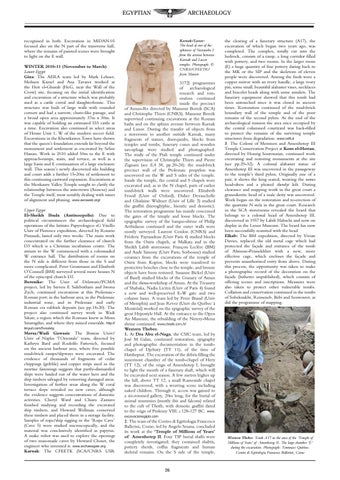
the clearing of a funerary structure (A17), the excavation of which began two years ago, was completed. The complex, totally cut into the bedrock, consists of a ramp, a long corridor filled with pottery, and two rooms. In the larger room (E) a huge quantity of fine pottery dating back to the MK or the SIP and the skeletons of eleven people were discovered. Among the finds were a copper mirror with an ivory handle, a large ivory pin, some small, beautiful alabaster vases, necklaces and bracelet beads along with some amulets. The funerary equipment showed that this tomb had been untouched since it was closed in ancient times. Restoration continued of the mud-brick boundary wall of the temple and of the poor remains of the second pylon. At the end of the archaeological mission the area once occupied by the central columned courtyard was back-filled to protect the remains of the surviving temple structures from degradation. www.cefb.it 3. The Colossi of Memnon and Amenhotep III Temple Conservation Project at Kom el-Hettan, directed by Hourig Sourouzian, continued work excavating and restoring monuments at the site (see pp.29-32). A colossal alabaster statue of Amenhotep III was uncovered in the passageway to the temple’s third pylon. Originally one of a pair, it shows the king seated, wearing the nemes head-dress and a pleated shendyt kilt. During clearance and mapping work in the great court a granodiorite head of a male deity was uncovered. Work began on the restoration and re-erection of the quartzite N stela in the great court. Research in the SCA storerooms revealed the beard that belongs to a colossal head of Amenhotep III, discovered in 1957 by Labib Habachi and now on display in the Luxor Museum. The beard has now been successfully reunited with the head. Elkab: The BM expedition, directed by Vivian Davies, replaced the old metal cage which had protected the façade and entrance of the tomb of Ahmose-Pennekhbet with a new, more effective cage, which encloses the façade and prevents unauthorized entry from above. During this process, the opportunity was taken to make a photographic record of the decoration on the façade (hitherto unpublished), which consists of offering scenes and inscriptions. Measures were also taken to protect other vulnerable tombs. Collation and conservation continued in the tombs of Sobeknakht, Renseneb, Bebi and Senwosret, as did the programme of mapping.
excavacionegipto.com
2. The team of the Centro di Egittologia Francesco Ballerini, Como, led by Angelo Sesana, concluded its work at the ‘Temple of Millions of Years’ of Amenhotep II. Four TIP burial shafts were completely investigated; they contained shabtis, pottery sherds, coffin fragments and human skeletal remains. On the S side of the temple,
26
Western Thebes: Tomb A17 in the area of the ‘Temple of Millions of Years’ of Amenhotep II. The large chamber ‘E’ during the excavation. Photograph: Tommaso Quirino. Centro di Egittologia Francesco Ballerini, Como