EGYPTIAN
ARCHAEOLOGY
Digging Diary 2010-11 Summaries of some of the archaeological work undertaken in Egypt in Winter 2010-11 and Spring 2011 appear below, with three from Autumn 2010 (see EA 38, pp.26-28). The sites are arranged geographically from north to south, ending with the oases. Archaeological work in Egypt was affected by the unrest in early 2011 with some expeditions leaving early and others cancelling their seasons, but most teams were able to work normally, apart from those in middle Egypt which continued to experience problems. Field Directors who would like reports on their work to appear in EA are asked to e-mail a short summary, with a website address if available, as soon as possible after the end of each season to: patricia.spencer@ees.ac.uk PATRICIA SPENCER Abbreviations: EDP Early Dynastic Period; OK Old Kingdom; FIP First Intermediate Period; MK Middle Kingdom; SIP Second Intermediate Period; NK New Kingdom; TIP Third Intermediate Period; LP Late Period; GR Graeco-Roman; DS EES Delta Survey; ERT Electrical Resistivity Tomography. Institutes and Research Centres: AERA Ancient Egypt Research Associates Inc; AUC American University in Cairo; BM British Museum, London; CFEETK Franco-Egyptian Centre, Karnak; CNRS French National Research Centre; CSIC Spanish National Research Council, Madrid; DAI German Institute, Cairo; MSA Ministry of State for Antiquities, Egypt; PCMA Polish Centre for Mediterranean Archaeology; SCA Supreme Council for Antiquities, Cairo: Swiss Inst Swiss Institute for Architectural Research and Archaeology, Cairo; USR research group of the CNRS.
AUTUMN 2010 (October to December) Lower Egypt Saqqara: The Louvre Museum expedition, directed by Guillemette Andreu and Michel Baud, excavated the W end of the large Coptic complex N of the Unas causeway, an annexe to the Monastery of St Jeremiah. Its three building phases were scrutinized in a 21m x 11m trial, showing a change from a high quality building with white mortar plastered walls (and even floor), to a later occupation oriented towards domestic activities before it was ultimately converted into a stable. Three neonates were found buried within the phase 3 building; two in a room and one in a corridor. Blocks from the mastaba of a ‘Priest of Neferirkara’ Nikaura were found reused in this level. The LP strata under the Coptic levels were investigated in some places, and more extensively along the Unas causeway, revealing more of a large funerary enclosure and neighbouring fosse burials, and also a vaulted tomb associated with a small mastaba possibly for respectively a mother and child. A deposit of pottery with large jars and small vessels of many different types was also brought to light; some rested on, and were covered by, mats. Upper Egypt Dahshur: The DAI/Free Univ Berlin team, led by Stephan J Seidlmayer and Nicole Alexanian, focused on a small excavation at the workmen’s settlement SW of the Red Pyramid. Several rooms with walls of rough limestone were cleaned and much 4th Dyn pottery, animal bones and charcoal were discovered. The work on the pottery excavated at the lower causeway of the Bent Pyramid in spring 2010 showed that the causeway
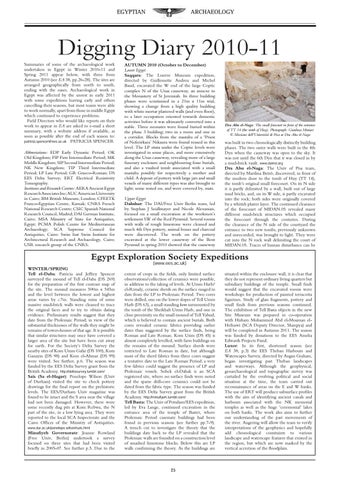
Dra Abu el-Naga: The small forecourt in front of the entrance of TT 14 (the tomb of Huy). Photograph: Gianluca Miniaci © Missione dell’Università di Pisa at Dra Abu el-Naga
was built in two chronologically distinctly building phases. The two outer walls were built in the 4th Dyn when the causeway was open to the sky. It was not until the 6th Dyn that it was closed in by a mud-brick vault. www.dainst.org Dra Abu el-Naga: The Univ of Pisa team, directed by Marilina Betrò, discovered, in front of the modern door to the tomb of Huy (TT 14), the tomb’s original small forecourt. On its N side it is partly delimited by a wall, built out of large mud bricks, and, on its W side, is partly excavated into the rock; both sides were originally covered by a whitish plaster layer. The continued clearance of the forecourt of MIDAN.05 revealed many different mud-brick structures which occupied the forecourt through the centuries. During the clearance of the N side of the courtyard the entrance to two new tombs, previously unknown and unrecorded, was brought to light. They were cut into the N rock wall delimiting the court of MIDAN.05. Traces of human disturbance can be
Egypt Exploration Society Expeditions WINTER/SPRING Tell el-Daba: Patricia and Jeffrey Spencer surveyed the mound of Tell el-Daba (DS 269) for the preparation of the first contour map of the site. The mound measures 500m x 545m and the level between the lowest and highest areas varies by c.7m. Standing ruins of some massive mud-brick walls were cleaned to trace the original faces and to try to obtain dating evidence. Preliminary results suggest that they date from the Ptolemaic Period; in view of the substantial thicknesses of the walls they might be remains of tower-houses of that age. It is possible that similar structures may once have covered a larger area of the site but have been cut away for earth. For the Society’s Delta Survey the nearby sites of Kom Umm Gafar (DS 100), Kom Ganayin (DS 98) and Kom el-Ahmar (DS 99) were visited. See further, p.6. The season was funded by the EES Delta Survey grant from the British Academy. http://deltasurvey.tumblr.com/ Sais (Sa el-Hagar): Penelope Wilson (Univ of Durham) visited the site to check pottery drawings for the final report on the prehistoric levels. The EES/Durham Univ magazine was found to be intact and the S area near the village had not been damaged. However, there were some recently dug pits at Kom Rebwa, the N part of the site, in a low lying area. They were reported to the local SCA Inspectorate and the Cairo Offices of the Ministry of Antiquities. www.dur.ac.uk/penelope.wilson/sais.html
Minufiyeh Governorate: Joanne Rowland (Free Univ, Berlin) undertook a survey focused on three sites that had been visited briefly in 2005-07. See further p.5. Due to the
(www.ees.ac.uk)
extent of crops in the fields, only limited surface observations/collection of ceramics were possible, in addition to the taking of levels. At Umm Harb/ el-Rimaly, ceramic sherds on the surface ranged in date from the LP to Ptolemaic Period. Two cores were drilled, one on the lower slopes of Tell Umm Harb (DS 63), a small standing kom surmounted by the tomb of the Sheikhah Umm Harb, and one in close proximity on the small mound of Tell Yahud, which is believed to contain ancient burials. Both cores revealed ceramic fabrics providing earlier dates than suggested by the surface finds, being Roman and Late Roman. Kom Usim (DS 45) is almost completely levelled, with farm buildings on the remains of the mound. Surface sherds were restricted to Late Roman in date, but although most of the sherd fabrics from three cores suggest a tentative date to the Late Roman Period, a very few fabrics could suggest the presence of LP and Ptolemaic vessels. Sobek el-Dahak is an SCA registered site, where no surface finds were noted and the sparse drill-core ceramics could not be dated from the fabric type. The season was funded by the EES Delta Survey grant from the British Academy. http://minufiyeh.tumblr.com/ Tell Basta: The Univ of Potsdam/EES expedition, led by Eva Lange, continued excavation in the entrance area of the temple of Bastet, where Ptolemaic Period casemate buildings had been found in previous seasons (see further pp.7-9). A trench cut to investigate the theory that the buildings date back to the LP revealed that the Ptolemaic walls are founded on a construction level of smashed limestone blocks. Below this are LP walls confirming the theory. As the buildings are
25
situated within the enclosure wall, it is clear that they do not represent ordinary living quarters but subsidiary buildings of the temple. Small finds would suggest that the excavated rooms were workshops for production of painted terracotta figurines. Study of glass fragments, pottery and small finds from previous seasons continued. The exhibition of Tell Basta objects in the new Site Museum was prepared in co-operation with Hisham Mohammed Abd el-Moaman elHefnawi (SCA Deputy Director, Sharqiya) and will be completed in Autumn 2011. The season was funded by donations to the EES Amelia Edwards Projects Fund. Luxor: In its first, shortened season (see EA 38, p.3) the EES Theban Harbours and Waterscapes Survey, directed by Angus Graham, began investigating past Theban landscapes and waterways. Although the geophysical, geoarchaeological and topographic survey was curtailed by the evolving political and social situation at the time, the team carried out reconnaissance of areas on the E and W banks. The use of ERT will produce subsurface profiles with the aim of identifying ancient canals and harbours associated with the NK memorial temples as well as the huge ‘ceremonial’ lakes on both banks. The work also aims to further our understanding of the past movements of the river. Augering will allow the team to verify interpretations of the geophysics and hopefully add chronological constraints to various landscape and waterscape features that existed in the region, but which are now masked by the vertical accretion of the floodplain.