EGYPTIAN
ARCHAEOLOGY
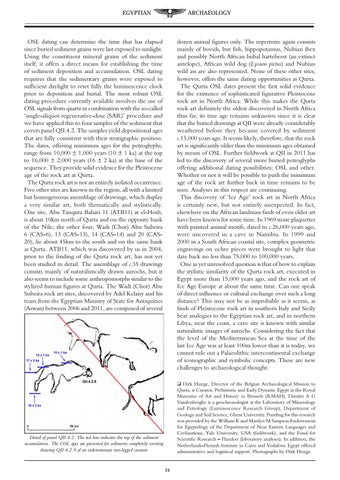
OSL dating can determine the time that has elapsed since buried sediment grains were last exposed to sunlight. Using the constituent mineral grains of the sediment itself, it offers a direct means for establishing the time of sediment deposition and accumulation. OSL dating requires that the sedimentary grains were exposed to sufficient daylight to reset fully the luminescence clock prior to deposition and burial. The most robust OSL dating procedure currently available involves the use of OSL signals from quartz in combination with the so-called ‘single-aliquot regenerative-dose (SAR)’ procedure and we have applied this to four samples of the sediment that covers panel QII.4.2. The samples yield depositional ages that are fully consistent with their stratigraphic position. The dates, offering minimum ages for the petroglyphs, range from 10,000 ± 1,000 years (10 ± 1 ka) at the top to 16,000 ± 2,000 years (16 ± 2 ka) at the base of the sequence. They provide solid evidence for the Pleistocene age of the rock art at Qurta. The Qurta rock art is not an entirely isolated occurrence. Five other sites are known in the region, all with a limited but homogeneous assemblage of drawings, which display a very similar art, both thematically and stylistically. One site, Abu Tanqura Bahari 11 (ATB11) at el-Hosh, is about 10km north of Qurta and on the opposite bank of the Nile; the other four, Wadi (Chor) Abu Subeira 6 (CAS-6), 13 (CAS-13), 14 (CAS-14) and 20 (CAS20), lie about 45km to the south and on the same bank as Qurta. ATB11, which was discovered by us in 2004, prior to the finding of the Qurta rock art, has not yet been studied in detail. The assemblage of c.35 drawings consists mainly of naturalistically drawn aurochs, but it also seems to include some anthropomorphs similar to the stylized human figures at Qurta. The Wadi (Chor) Abu Subeira rock art sites, discovered by Adel Kelany and his team from the Egyptian Ministry of State for Antiquities (Aswan) between 2006 and 2011, are composed of several
dozen animal figures only. The repertoire again consists mainly of bovids, but fish, hippopotamus, Nubian ibex and possibly North African bubal hartebeest (an extinct antelope), African wild dog (Lycaon pictus) and Nubian wild ass are also represented. None of these other sites, however, offers the same dating opportunities as Qurta. The Qurta OSL dates present the first solid evidence for the existence of sophisticated figurative Pleistocene rock art in North Africa. While this makes the Qurta rock art definitely the oldest discovered in North Africa thus far, its true age remains unknown since it is clear that the buried drawings at QII were already considerably weathered before they became covered by sediment c.15,000 years ago. It seems likely, therefore, that the rock art is significantly older than the minimum ages obtained by means of OSL. Further fieldwork at QII in 2011 has led to the discovery of several more buried petroglyphs offering additional dating possibilities; OSL and other. Whether or not it will be possible to push the minimum age of the rock art further back in time remains to be seen. Analyses in this respect are continuing. This discovery of ‘Ice Age’ rock art in North Africa is certainly new, but not entirely unexpected. In fact, elsewhere on the African landmass finds of even older art have been known for some time. In 1969 stone plaquettes with painted animal motifs, dated to c.26,000 years ago, were uncovered in a cave in Namibia. In 1999 and 2000 in a South African coastal site, complex geometric engravings on ochre pieces were brought to light that date back no less than 75,000 to 100,000 years. One as yet unresolved question is that of how to explain the stylistic similarity of the Qurta rock art, executed in Egypt more than 15,000 years ago, and the rock art of Ice Age Europe at about the same time. Can one speak of direct influence or cultural exchange over such a long distance? This may not be as improbable as it seems, as finds of Pleistocene rock art in southern Italy and Sicily bear analogies to the Egyptian rock art, and in northern Libya, near the coast, a cave site is known with similar naturalistic images of aurochs. Considering the fact that the level of the Mediterranean Sea at the time of the last Ice Age was at least 100m lower than it is today, we cannot rule out a Palaeolithic intercontinental exchange of iconographic and symbolic concepts. These are new challenges to archaeological thought. q Dirk Huyge, Director of the Belgian Archaeological Mission to Qurta, is Curator, Prehistoric and Early Dynastic Egypt at the Royal Museums of Art and History in Brussels (RMAH). Dimitri A G Vandenberghe is a geochronologist at the Laboratory of Mineralogy and Petrology (Luminescence Research Group), Department of Geology and Soil Science, Ghent University. Funding for this research was provided by the William K and Marilyn M Simpson Endowment for Egyptology of the Department of Near Eastern Languages and Civilizations, Yale University, USA (fieldwork), and the Fund for Scientific Research – Flanders (laboratory analyses). In addition, the Netherlands-Flemish Institute in Cairo and Vodafone Egypt offered administrative and logistical support. Photographs by Dirk Huyge.
Detail of panel QII.4.2. The red line indicates the top of the sediment accumulation. The OSL ages are presented for sediments completely covering drawing QII.4.2.9 of an indeterminate two-legged creature
24