EGYPTIAN
ARCHAEOLOGY
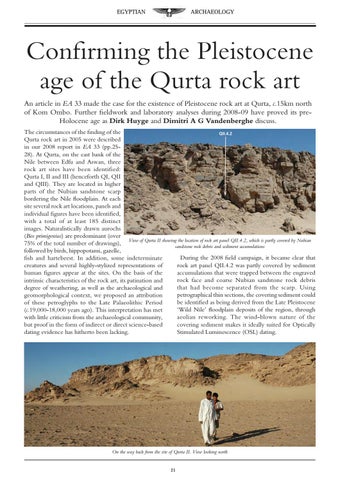
Confirming the Pleistocene age of the Qurta rock art An article in EA 33 made the case for the existence of Pleistocene rock art at Qurta, c.15km north of Kom Ombo. Further fieldwork and laboratory analyses during 2008-09 have proved its preHolocene age as Dirk Huyge and Dimitri A G Vandenberghe discuss. The circumstances of the finding of the Qurta rock art in 2005 were described in our 2008 report in EA 33 (pp.2528). At Qurta, on the east bank of the Nile between Edfu and Aswan, three rock art sites have been identified: Qurta I, II and III (henceforth QI, QII and QIII). They are located in higher parts of the Nubian sandstone scarp bordering the Nile floodplain. At each site several rock art locations, panels and individual figures have been identified, with a total of at least 185 distinct images. Naturalistically drawn aurochs (Bos primigenius) are predominant (over View of Qurta II showing the location of rock art panel QII.4.2, which is partly covered by Nubian 75% of the total number of drawings), sandstone rock debris and sediment accumulations followed by birds, hippopotami, gazelle, During the 2008 field campaign, it became clear that fish and hartebeest. In addition, some indeterminate rock art panel QII.4.2 was partly covered by sediment creatures and several highly-stylized representations of accumulations that were trapped between the engraved human figures appear at the sites. On the basis of the rock face and coarse Nubian sandstone rock debris intrinsic characteristics of the rock art, its patination and that had become separated from the scarp. Using degree of weathering, as well as the archaeological and petrographical thin sections, the covering sediment could geomorphological context, we proposed an attribution be identified as being derived from the Late Pleistocene of these petroglyphs to the Late Palaeolithic Period ‘Wild Nile’ floodplain deposits of the region, through (c.19,000-18,000 years ago). This interpretation has met aeolian reworking. The wind-blown nature of the with little criticism from the archaeological community, covering sediment makes it ideally suited for Optically but proof in the form of indirect or direct science-based Stimulated Luminescence (OSL) dating. dating evidence has hitherto been lacking.
On the way back from the site of Qurta II. View looking north 21