EGYPTIAN
ARCHAEOLOGY
Graffito recording ‘Saqr’, the name of the royal palace at Shabwa, capital of the South Arabian kingdom of Hadramaut. Scale: 2cm
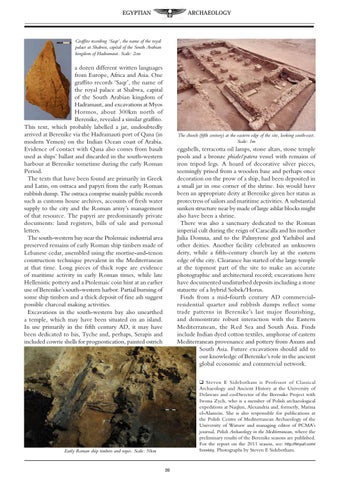
a dozen different written languages from Europe, Africa and Asia. One graffito records ‘Saqr’, the name of the royal palace at Shabwa, capital of the South Arabian kingdom of Hadramaut, and excavations at Myos Hormos, about 300km north of Berenike, revealed a similar graffito. This text, which probably labelled a jar, undoubtedly arrived at Berenike via the Hadramauti port of Qana (in modern Yemen) on the Indian Ocean coast of Arabia. Evidence of contact with Qana also comes from basalt used as ships’ ballast and discarded in the south-western harbour at Berenike sometime during the early Roman Period. The texts that have been found are primarily in Greek and Latin, on ostraca and papyri from the early Roman rubbish dump. The ostraca comprise mainly public records such as customs house archives, accounts of fresh water supply to the city and the Roman army’s management of that resource. The papyri are predominantly private documents: land registers, bills of sale and personal letters. The south-western bay near the Ptolemaic industrial area preserved remains of early Roman ship timbers made of Lebanese cedar, assembled using the mortise-and-tenon construction technique prevalent in the Mediterranean at that time. Long pieces of thick rope are evidence of maritime activity in early Roman times, while late Hellenistic pottery and a Ptolemaic coin hint at an earlier use of Berenike’s south-western harbor. Partial burning of some ship timbers and a thick deposit of fine ash suggest possible charcoal making activities. Excavations in the south-western bay also unearthed a temple, which may have been situated on an island. In use primarily in the fifth century AD, it may have been dedicated to Isis, Tyche and, perhaps, Serapis and included cowrie shells for prognostication, painted ostrich
The church (fifth century) at the eastern edge of the site, looking south-east. Scale: 1m
eggshells, terracotta oil lamps, stone altars, stone temple pools and a bronze phiale/patera vessel with remains of iron tripod legs. A hoard of decorative silver pieces, seemingly prised from a wooden base and perhaps once decoration on the prow of a ship, had been deposited in a small jar in one corner of the shrine. Isis would have been an appropriate deity at Berenike given her status as protectress of sailors and maritime activities. A substantial sunken structure near by made of large ashlar blocks might also have been a shrine. There was also a sanctuary dedicated to the Roman imperial cult during the reign of Caracalla and his mother Julia Domna, and to the Palmyrene god Yarhibol and other deities. Another facility celebrated an unknown deity, while a fifth-century church lay at the eastern edge of the city. Clearance has started of the large temple at the topmost part of the site to make an accurate photographic and architectural record; excavations here have documented undisturbed deposits including a stone statuette of a hybrid Sobek/Horus. Finds from a mid-fourth century AD commercialresidential quarter and rubbish dumps reflect some trade patterns in Berenike’s last major flourishing, and demonstrate robust interaction with the Eastern Mediterranean, the Red Sea and South Asia. Finds include Indian dyed cotton textiles, amphorae of eastern Mediterranean provenance and pottery from Axum and South Asia. Future excavations should add to our knowledge of Berenike’s role in the ancient global economic and commercial network. q Steven E Sidebotham is Professor of Classical Archaeology and Ancient History at the University of Delaware and co-Director of the Berenike Project with Iwona Zych, who is a member of Polish archaeological expeditions at Naqlun, Alexandria and, formerly, Marina el-Alamein. She is also responsible for publications at the Polish Centre of Mediterranean Archaeology of the University of Warsaw and managing editor of PCMA’s journal, Polish Archaeology in the Mediterranean, where the preliminary results of the Berenike seasons are published. For the report on the 2011 season, see: http://tinyurl.com/ 5vxx66y. Photographs by Steven E Sidebotham.
Early Roman ship timbers and ropes. Scale: 50cm 20