EGYPTIAN
ARCHAEOLOGY
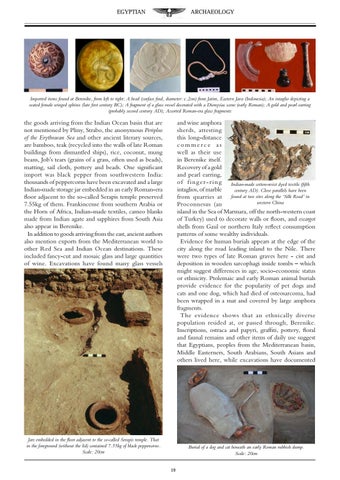
Imported items found at Berenike, from left to right: A bead (surface find, diameter: c.2cm) from Jatim, Eastern Java (Indonesia); An intaglio depicting a seated female winged sphinx (late first century BC); A fragment of a glass vessel decorated with a Dionysiac scene (early Roman); A gold and pearl earring (probably second century AD); Assorted Roman-era glass fragments
the goods arriving from the Indian Ocean basin that are not mentioned by Pliny, Strabo, the anonymous Periplus of the Erythraean Sea and other ancient literary sources, are bamboo, teak (recycled into the walls of late Roman buildings from dismantled ships), rice, coconut, mung beans, Job’s tears (grains of a grass, often used as beads), matting, sail cloth, pottery and beads. One significant import was black pepper from southwestern India: thousands of peppercorns have been excavated and a large Indian-made storage jar embedded in an early Roman-era floor adjacent to the so-called Serapis temple preserved 7.55kg of them. Frankincense from southern Arabia or the Horn of Africa, Indian-made textiles, cameo blanks made from Indian agate and sapphires from South Asia also appear in Berenike. In addition to goods arriving from the east, ancient authors also mention exports from the Mediterranean world to other Red Sea and Indian Ocean destinations. These included fancy-cut and mosaic glass and large quantities of wine. Excavations have found many glass vessels
and wine amphora sherds, attesting this long-distance commerce as well as their use in Berenike itself. Recovery of a gold and pearl earring, of finger-ring Indian-made cotton-resist dyed textile (fifth intaglios, of marble century AD). Close parallels have been from quarries at found at two sites along the ‘Silk Road’ in western China Proconnesus (an island in the Sea of Marmara, off the north-western coast of Turkey) used to decorate walls or floors, and escargot shells from Gaul or northern Italy reflect consumption patterns of some wealthy individuals. Evidence for human burials appears at the edge of the city along the road leading inland to the Nile. There were two types of late Roman graves here - cist and deposition in wooden sarcophagi inside tombs – which might suggest differences in age, socio-economic status or ethnicity. Ptolemaic and early Roman animal burials provide evidence for the popularity of pet dogs and cats and one dog, which had died of osteosarcoma, had been wrapped in a mat and covered by large amphora fragments. The evidence shows that an ethnically diverse population resided at, or passed through, Berenike. Inscriptions, ostraca and papyri, graffiti, pottery, floral and faunal remains and other items of daily use suggest that Egyptians, peoples from the Mediterranean basin, Middle Easterners, South Arabians, South Asians and others lived here, while excavations have documented
Jars embedded in the floor adjacent to the so-called Serapis temple. That in the foreground (without the lid) contained 7.55kg of black peppercorns. Scale: 20cm
Burial of a dog and cat beneath an early Roman rubbish dump. Scale: 20cm 19