EGYPTIAN
ARCHAEOLOGY
Berenike: Egypt’s Red Sea gateway to the east The Red Sea emporium of Berenike has been under investigation since 1994 (see EA 8, pp.15-17). Steven E Sidebotham and Iwona Zych summarise the results of recent fieldwork. Berenike, a major Ptolemaic and Roman port on Egypt’s Red Sea coast, was active from its founding by Ptolemy II Philadelphus in c.275 BC until its abandonment before the middle of the sixth century AD. For approximately eight centuries it was a major intermediary in commercial and cultural exchanges between the Mediterranean world and areas of the Red Sea-Indian Ocean basin. Fieldwork at the site has been conducted for eleven seasons by the University of Delaware, Leiden University, the University of California Los Angeles and the Polish Centre of Mediterranean Archaeology at the University of Warsaw. There were three peak periods in Berenike’s history: the early-middle part of the Ptolemaic Period (mid-third to second century BC), the early Roman Empire (first to second century AD) and the late Roman Period (midfourth to fifth century AD). Demotic ostraca have been documented from Ptolemaic and early Roman rubbish deposits in the city. In Ptolemaic times trade through the port was mainly for the government and Berenike’s primary role was the acquisition of elephants to serve in the army, though ivory was also imported, both at that time and later. Excavations at the western edge of the settlement have revealed elephant teeth and a possible elephant holding
The possible elephant holding pen in the Ptolemaic industrial area. Scale: 50cm
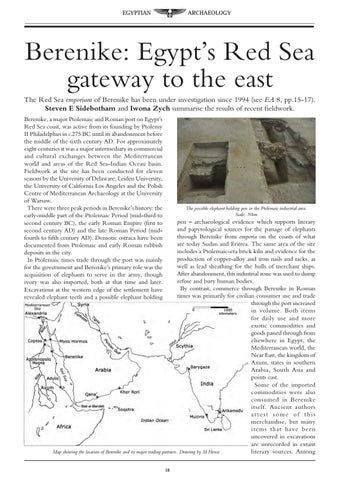
pen – archaeological evidence which supports literary and papyrological sources for the passage of elephants through Berenike from emporia on the coasts of what are today Sudan and Eritrea. The same area of the site includes a Ptolemaic-era brick kiln and evidence for the production of copper-alloy and iron nails and tacks, as well as lead sheathing for the hulls of merchant ships. After abandonment, this industrial zone was used to dump refuse and bury human bodies. By contrast, commerce through Berenike in Roman times was primarily for civilian consumer use and trade through the port increased in volume. Both items for daily use and more exotic commodities and goods passed through from elsewhere in Egypt, the Mediterranean world, the Near East, the kingdom of Axum, states in southern Arabia, South Asia and points east. Some of the imported commodities were also consumed in Berenike itself. Ancient authors attest some of this merchandise, but many items that have been uncovered in excavations are unrecorded in extant literary sources. Among Map showing the location of Berenike and its major trading partners. Drawing by M Hense 18