EGYPTIAN
ARCHAEOLOGY
PEETERS P U B L I S H E R S Egypt at its Origins 3 R.F FRIEdman & P.n. FISkE (eds.) This volume, publishing the proceedings of the Third International Conference on Predynastic and Early dynastic Egypt (London, 2008), presents the results of the latest research and discoveries in the field which are leading to a better understanding of the origins of the ancient Egyptian civilization. It contains 54 contributions by 67 authors hailing from around the globe. Each contribution provides new insights into the variety of factors contributing to the rise of the distinct form of the early Egyptian state. Recent discoveries from major sites such as Hierakonpolis, abydos, and Tell el Farkha, amongst others, are also discussed in detail. 2011 – Orientalia Lovaniensia analecta 205 – XXIV-1292 p. ISBn 978-90-429-2490-1 – hardcover – 125 euro
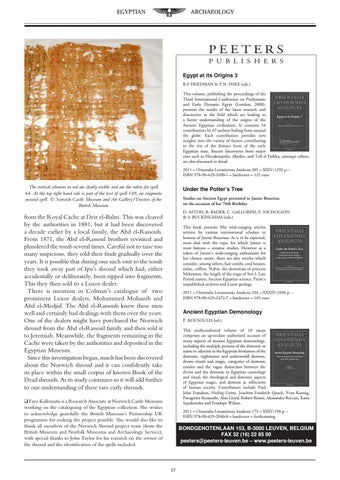
The vertical columns in red are clearly visible and are the rubric for spell 64. At the top right hand side is part of the text of spell 149, an enigmatic mound spell. © Norwich Castle Museum and Art Gallery/Trustees of the British Museum
from the Royal Cache at Deir el-Bahri. This was cleared by the authorities in 1881, but it had been discovered a decade earlier by a local family, the Abd el-Rassouls. From 1871, the Abd el-Rassoul brothers revisited and plundered the tomb several times. Careful not to raise too many suspicions, they sold their finds gradually over the years. It is possible that during one such visit to the tomb they took away part of Ipu’s shroud which had, either accidentally or deliberately, been ripped into fragments. This they then sold to a Luxor dealer. There is mention in Colman’s catalogue of two prominent Luxor dealers, Mohammed Mohassib and Abd el-Medjid. The Abd el-Rassouls knew these men well and certainly had dealings with them over the years. One of the dealers might have purchased the Norwich shroud from the Abd el-Rassoul family and then sold it to Jeremiah. Meanwhile, the fragments remaining in the Cache were taken by the authorities and deposited in the Egyptian Museum. Since this investigation began, much has been discovered about the Norwich shroud and it can confidently take its place within the small corpus of known Book of the Dead shrouds. As its study continues so it will add further to our understanding of these rare early shrouds. q Faye Kalloniatis is a Research Associate at Norwich Castle Museum working on the cataloguing of the Egyptian collection. She wishes to acknowledge gratefully the British Museum’s Partnership UK programme for making the project possible. She would also like to thank all members of the Norwich Shroud project team (from the British Museum and Norfolk Museums and Archaeology Service), with special thanks to John Taylor for his research on the owner of the shroud and the identification of the spells included.
Under the Potter’s Tree Studies on Ancient Egypt presented to Janine Bourriau on the occasion of her 70th Birthday d. aSTOn, B. BadER, C. GaLLORInI, P. nICHOLSOn & S. BUCkInGHam (eds.) This book presents fifty wide-ranging articles written by various international scholars in honour of Janine Bourriau. as is to be expected, most deal with the topic for which Janine is most famous – ceramic studies. However as a token of Janine’s wide-ranging enthusiasm for her chosen career, there are also articles which consider, among others, hair combs, soul houses, stelae, coffins, nubia, the dormitian of princess meketaten, the length of the reign of Seti I, Late Period names, ancient Egyptian science, Petrie’s unpublished archives and Luxor geology. 2011 – Orientalia Lovaniensia analecta 204 – XXXIV-1036 p. ISBn 978-90-429-2472-7 – hardcover – 105 euro
Ancient Egyptian Demonology P. kOUSOULIS (ed.) This multi-authored volume of 10 essays comprises an up-to-date authorized account of many aspects of ancient Egyptian demonology, including the multiple persona of the demonic or name vs. identity in the Egyptian formation of the demonic, nightmares and underworld demons, dream rituals and magic, categories of demonic entities and the vague distinction between the divine and the demonic in Egyptian cosmology and ritual, the theological and demonic aspects of Egyptian magic, and demons as reflections of human society. Contributors include Paul John Frandsen, Hedvig Györy, Joachim Friedrich Quack, Yvan koenig, Panagiotis kousoulis, alan Lloyd, Robert Ritner, alessandro Roccati, kasia Szpakowska and Penelope Wilson. 2011 – Orientalia Lovaniensia analecta 175 – XXIV-198 p. ISBn 978-90-429-2040-8 – hardcover – forthcoming
BONDGENOTENLAAN 153, B-3000 LEUVEN, BELGiUm FAX 32 (16) 22 85 00 peeters@peeters-leuven.be – www.peeters-leuven.be
94322_Adv_EgyptArcheo.indd 1 17