EGYPTIAN
ARCHAEOLOGY
the shroud’s recent conservation at the British Museum, and a remarkable history has begun to emerge. Dated to the early Eighteenth Dynasty, it is approximately 3,500 years old and belonged to a lady called Ipu, daughter of Mutresti. Both names were common at that time. Ipu’s title is not recorded on the Norwich shroud, but, by a stroke of sheer good fortune, it has been established that further fragments of her shroud exist in the Egyptian Museum, Cairo. These give Ipu’s title as ‘khekeret nesu’, sometimes translated as the ‘king’s ornament’. The precise meaning of the title is not certain but it is known that it was often held by women of high status. So Ipu was a well-to-do lady of some importance. The cursive hieroglyphic text, in vertical columns of black (and some red) ink, covers most of the surface. The inscriptions are written in the same hand throughout and contain a selection of spells from the Book of the Dead. These were designed to help the deceased in their journey to the afterlife. One of the best preserved is spell 64, a cryptic text which includes passages about the nature of the creator god and the supernatural powers
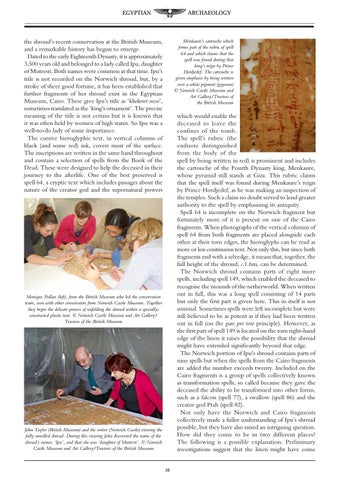
Menkaure’s cartouche which forms part of the rubric of spell 64 and which claims that the spell was found during that king’s reign by Prince Hordjedef. The cartouche is given emphasis by being written over a white pigment (gypsum) © Norwich Castle Museum and Art Gallery/Trustees of the British Museum
which would enable the deceased to leave the confines of the tomb. The spell’s rubric (the endnote distinguished from the body of the spell by being written in red) is prominent and includes the cartouche of the Fourth Dynasty king, Menkaure, whose pyramid still stands at Giza. This rubric claims that the spell itself was found during Menkaure’s reign by Prince Hordjedef, as he was making an inspection of the temples. Such a claim no doubt served to lend greater authority to the spell by emphasising its antiquity. Spell 64 is incomplete on the Norwich fragment but fortunately more of it is present on one of the Cairo fragments. When photographs of the vertical columns of spell 64 from both fragments are placed alongside each other at their torn edges, the hieroglyphs can be read as more or less continuous text. Not only this, but since both fragments end with a selvedge, it means that, together, the full height of the shroud, c.1.6m, can be determined. The Norwich shroud contains parts of eight more spells, including spell 149, which enabled the deceased to recognise the mounds of the netherworld. When written out in full, this was a long spell consisting of 14 parts but only the first part is given here. This in itself is not unusual. Sometimes spells were left incomplete but were still believed to be as potent as if they had been written out in full (on the pars pro toto principle). However, as the first part of spell 149 is located on the torn right-hand edge of the linen it raises the possibility that the shroud might have extended significantly beyond that edge. The Norwich portion of Ipu’s shroud contains parts of nine spells but when the spells from the Cairo fragments are added the number exceeds twenty. Included on the Cairo fragments is a group of spells collectively known as transformation spells, so called because they gave the deceased the ability to be transformed into other forms, such as a falcon (spell 77), a swallow (spell 86) and the creator god Ptah (spell 82). Not only have the Norwich and Cairo fragments collectively made a fuller understanding of Ipu’s shroud possible, but they have also raised an intriguing question. How did they come to be in two different places? The following is a possible explanation. Preliminary investigations suggest that the linen might have come
Monique Pullan (left), from the British Museum who led the conservation team, seen with other conservators from Norwich Castle Museum. Together they begin the delicate process of unfolding the shroud within a speciallyconstructed plastic tent. © Norwich Castle Museum and Art Gallery/ Trustees of the British Museum
John Taylor (British Museum) and the writer (Norwich Castle) viewing the fully unrolled shroud. During this viewing John discovered the name of the shroud’s owner, ‘Ipu’, and that she was ‘daughter of Mutresti’. © Norwich Castle Museum and Art Gallery/Trustees of the British Museum
16