EGYPTIAN
ARCHAEOLOGY
The shroud of Ipu at Norwich Castle Museum
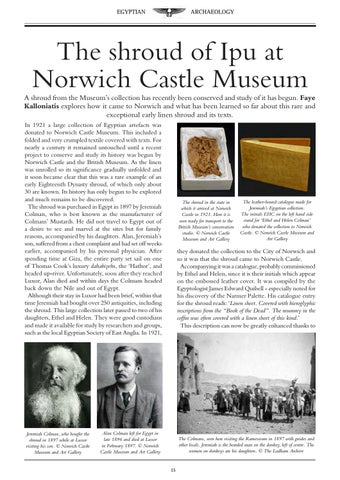
A shroud from the Museum’s collection has recently been conserved and study of it has begun. Faye Kalloniatis explores how it came to Norwich and what has been learned so far about this rare and exceptional early linen shroud and its texts. In 1921 a large collection of Egyptian artefacts was donated to Norwich Castle Museum. This included a folded and very crumpled textile covered with texts. For nearly a century it remained untouched until a recent project to conserve and study its history was begun by Norwich Castle and the British Museum. As the linen was unrolled so its significance gradually unfolded and it soon became clear that this was a rare example of an early Eighteenth Dynasty shroud, of which only about 30 are known. Its history has only begun to be explored and much remains to be discovered. The shroud was purchased in Egypt in 1897 by Jeremiah Colman, who is best known as the manufacturer of Colmans’ Mustards. He did not travel to Egypt out of a desire to see and marvel at the sites but for family reasons, accompanied by his daughters. Alan, Jeremiah’s son, suffered from a chest complaint and had set off weeks earlier, accompanied by his personal physician. After spending time at Giza, the entire party set sail on one of Thomas Cook’s luxury dahabiyehs, the ‘Hathor’, and headed up-river. Unfortunately, soon after they reached Luxor, Alan died and within days the Colmans headed back down the Nile and out of Egypt. Although their stay in Luxor had been brief, within that time Jeremiah had bought over 250 antiquities, including the shroud. This large collection later passed to two of his daughters, Ethel and Helen. They were good custodians and made it available for study by researchers and groups, such as the local Egyptian Society of East Anglia. In 1921,
Jeremiah Colman, who bought the shroud in 1897 while at Luxor visiting his son. © Norwich Castle Museum and Art Gallery
The shroud in the state in which it arrived at Norwich Castle in 1921. Here it is seen ready for transport to the British Museum’s conservation studio. © Norwich Castle Museum and Art Gallery
The leather-bound catalogue made for Jeremiah’s Egyptian collection. The initials EHC on the left hand side stand for ‘Ethel and Helen Colman’ who donated the collection to Norwich Castle. © Norwich Castle Museum and Art Gallery
they donated the collection to the City of Norwich and so it was that the shroud came to Norwich Castle. Accompanying it was a catalogue, probably commissioned by Ethel and Helen, since it is their initials which appear on the embossed leather cover. It was compiled by the Egyptologist James Edward Quibell - especially noted for his discovery of the Narmer Palette. His catalogue entry for the shroud reads: ‘Linen sheet. Covered with hieroglyphic inscriptions from the “Book of the Dead”. The mummy in the coffin was often covered with a linen sheet of this kind.’ This description can now be greatly enhanced thanks to
Alan Colman left for Egypt in late 1896 and died at Luxor in February 1897. © Norwich Castle Museum and Art Gallery
The Colmans, seen here visiting the Ramesseum in 1897 with guides and other locals. Jeremiah is the bearded man on the donkey, left of centre. The women on donkeys are his daughters. © The Ludham Archive 15