EGYPTIAN
ARCHAEOLOGY
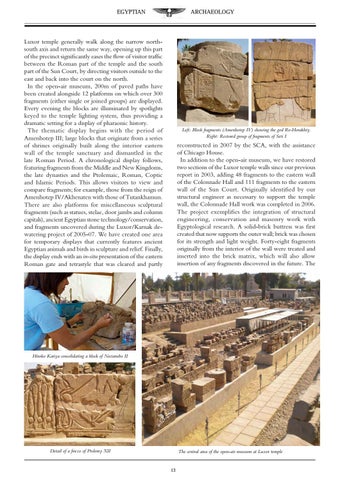
Luxor temple generally walk along the narrow northsouth axis and return the same way, opening up this part of the precinct significantly eases the flow of visitor traffic between the Roman part of the temple and the south part of the Sun Court, by directing visitors outside to the east and back into the court on the north. In the open-air museum, 200m of paved paths have been created alongside 12 platforms on which over 300 fragments (either single or joined groups) are displayed. Every evening the blocks are illuminated by spotlights keyed to the temple lighting system, thus providing a dramatic setting for a display of pharaonic history. The thematic display begins with the period of Amenhotep III; large blocks that originate from a series of shrines originally built along the interior eastern wall of the temple sanctuary and dismantled in the late Roman Period. A chronological display follows, featuring fragments from the Middle and New Kingdoms, the late dynasties and the Ptolemaic, Roman, Coptic and Islamic Periods. This allows visitors to view and compare fragments; for example, those from the reign of Amenhotep IV/Akhenaten with those of Tutankhamun. There are also platforms for miscellaneous sculptural fragments (such as statues, stelae, door jambs and column capitals), ancient Egyptian stone technology/conservation, and fragments uncovered during the Luxor/Karnak dewatering project of 2005-07. We have created one area for temporary displays that currently features ancient Egyptian animals and birds in sculpture and relief. Finally, the display ends with an in-situ presentation of the eastern Roman gate and tetrastyle that was cleared and partly
Left: Block fragments (Amenhotep IV) showing the god Re-Horakhty. Right: Restored group of fragments of Seti I
reconstructed in 2007 by the SCA, with the assistance of Chicago House. In addition to the open-air museum, we have restored two sections of the Luxor temple walls since our previous report in 2003, adding 48 fragments to the eastern wall of the Colonnade Hall and 111 fragments to the eastern wall of the Sun Court. Originally identified by our structural engineer as necessary to support the temple wall, the Colonnade Hall work was completed in 2006. The project exemplifies the integration of structural engineering, conservation and masonry work with Egyptological research. A solid-brick buttress was first created that now supports the outer wall; brick was chosen for its strength and light weight. Forty-eight fragments originally from the interior of the wall were treated and inserted into the brick matrix, which will also allow insertion of any fragments discovered in the future. The
Hiroko Kariya consolidating a block of Nectanebo II
Detail of a frieze of Ptolemy XII
The central area of the open-air museum at Luxor temple 13