EGYPTIAN
ARCHAEOLOGY
Luxor temple: conservation and site-management In 2003 EA 22 (pp.21-24) featured a report on the work of the Luxor Temple Wall Fragment Project. Hiroko Kariya and Ray Johnson describe how the project has since continued and developed. During the 2009-10 season the Epigraphic Survey of the Oriental Institute, University of Chicago (Chicago House) accomplished two major conservation projects at Luxor temple; creating public access to a representative fragment display (referred to as the ‘blockyard open-air museum’ below) and reconstruction of 111 fragments on the east wall of the Sun Court of Amenhotep III. The current conservation project in Luxor temple began in 1995 and involved approximately 2,000 inscribed fragments which had been identified, documented and photographed by Chicago House during the 1970s and 1980s and came originally from the walls of the Colonnade Hall and Amenhotep III Sun Court. The project’s original focus on documentation, treatment and condition monitoring evolved to include emergency protection and sorting of an additional 50,000 inscribed fragments which had been removed during the medieval period from walls at the Luxor and Karnak temples, for reuse as building materials. They had been excavated in modern times around the temple’s precinct and stored directly on ground that was eventually contaminated with salt-laden ground water. As we witnessed some
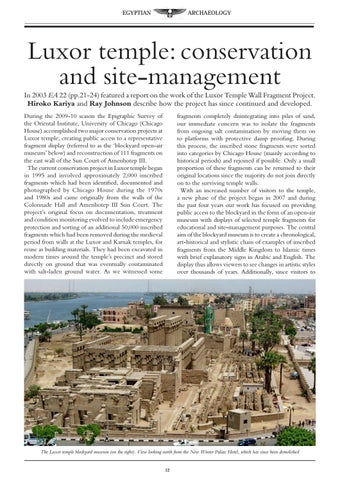
fragments completely disintegrating into piles of sand, our immediate concern was to isolate the fragments from ongoing salt contamination by moving them on to platforms with protective damp proofing. During this process, the inscribed stone fragments were sorted into categories by Chicago House (mainly according to historical periods) and rejoined if possible. Only a small proportion of these fragments can be returned to their original locations since the majority do not join directly on to the surviving temple walls. With an increased number of visitors to the temple, a new phase of the project began in 2007 and during the past four years our work has focused on providing public access to the blockyard in the form of an open-air museum with displays of selected temple fragments for educational and site-management purposes. The central aim of the blockyard museum is to create a chronological, art-historical and stylistic chain of examples of inscribed fragments from the Middle Kingdom to Islamic times with brief explanatory signs in Arabic and English. The display thus allows viewers to see changes in artistic styles over thousands of years. Additionally, since visitors to
The Luxor temple blockyard museum (on the right). View looking north from the New Winter Palace Hotel, which has since been demolished 12