EGYPTIAN
ARCHAEOLOGY
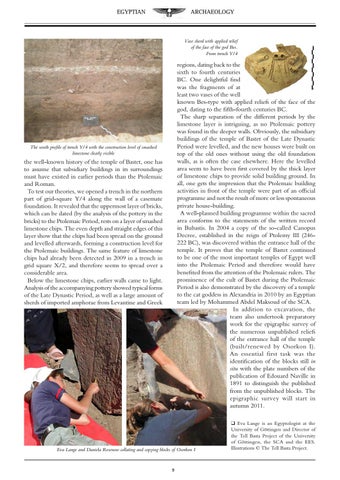
Vase sherd with applied relief of the face of the god Bes. From trench Y/4
regions, dating back to the sixth to fourth centuries BC. One delightful find was the fragments of at least two vases of the well known Bes-type with applied reliefs of the face of the god, dating to the fifth-fourth centuries BC. The sharp separation of the different periods by the limestone layer is intriguing, as no Ptolemaic pottery was found in the deeper walls. Obviously, the subsidiary buildings of the temple of Bastet of the Late Dynastic Period were levelled, and the new houses were built on top of the old ones without using the old foundation walls, as is often the case elsewhere. Here the levelled area seem to have been first covered by the thick layer of limestone chips to provide solid building ground. In all, one gets the impression that the Ptolemaic building activities in front of the temple were part of an official programme and not the result of more or less spontaneous private house-building. A well-planned building programme within the sacred area conforms to the statements of the written record in Bubastis. In 2004 a copy of the so-called Canopus Decree, established in the reign of Ptolemy III (246222 BC), was discovered within the entrance hall of the temple. It proves that the temple of Bastet continued to be one of the most important temples of Egypt well into the Ptolemaic Period and therefore would have benefited from the attention of the Ptolemaic rulers. The prominence of the cult of Bastet during the Ptolemaic Period is also demonstrated by the discovery of a temple to the cat goddess in Alexandria in 2010 by an Egyptian team led by Mohammed Abdel Maksoud of the SCA. In addition to excavation, the team also undertook preparatory work for the epigraphic survey of the numerous unpublished reliefs of the entrance hall of the temple (built/renewed by Osorkon I). An essential first task was the identification of the blocks still in situ with the plate numbers of the publication of Edouard Naville in 1891 to distinguish the published from the unpublished blocks. The epigraphic survey will start in autumn 2011.
The south profile of trench Y/4 with the construction level of smashed limestone clearly visible
the well-known history of the temple of Bastet, one has to assume that subsidiary buildings in its surroundings must have existed in earlier periods than the Ptolemaic and Roman. To test our theories, we opened a trench in the northern part of grid-square Y/4 along the wall of a casemate foundation. It revealed that the uppermost layer of bricks, which can be dated (by the analysis of the pottery in the bricks) to the Ptolemaic Period, rests on a layer of smashed limestone chips. The even depth and straight edges of this layer show that the chips had been spread on the ground and levelled afterwards, forming a construction level for the Ptolemaic buildings. The same feature of limestone chips had already been detected in 2009 in a trench in grid square X/2, and therefore seems to spread over a considerable area. Below the limestone chips, earlier walls came to light. Analysis of the accompanying pottery showed typical forms of the Late Dynastic Period, as well as a large amount of sherds of imported amphorae from Levantine and Greek
Eva Lange and Daniela Rosenow collating and copying blocks of Osorkon I
q Eva Lange is an Egyptologist at the University of Göttingen and Director of the Tell Basta Project of the University of Göttingen, the SCA and the EES. Illustrations © The Tell Basta Project.