EGYPTIAN
ARCHAEOLOGY
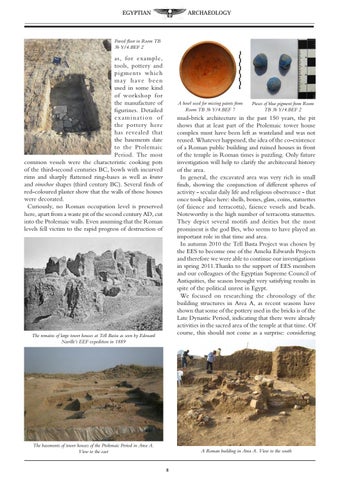
Paved floor in Room TB 3b Y/4.BEF 2
as, for example, tools, pottery and pigments which may have been used in some kind of workshop for the manufacture of figurines. Detailed examination of the pottery here has revealed that the basements date to the Ptolemaic Period. The most common vessels were the characteristic cooking pots of the third-second centuries BC, bowls with incurved rims and sharply flattened ring-bases as well as krater and oinochoe shapes (third century BC). Several finds of red-coloured plaster show that the walls of those houses were decorated. Curiously, no Roman occupation level is preserved here, apart from a waste pit of the second century AD, cut into the Ptolemaic walls. Even assuming that the Roman levels fell victim to the rapid progress of destruction of
A bowl used for mixing paints from Room TB 3b Y/4.BEF 7
Pieces of blue pigment from Room TB 3b Y/4.BEF 2
mud-brick architecture in the past 150 years, the pit shows that at least part of the Ptolemaic tower house complex must have been left as wasteland and was not reused. Whatever happened, the idea of the co-existence of a Roman public building and ruined houses in front of the temple in Roman times is puzzling. Only future investigation will help to clarify the architecural history of the area. In general, the excavated area was very rich in small finds, showing the conjunction of different spheres of activity - secular daily life and religious observance - that once took place here: shells, bones, glass, coins, statuettes (of faience and terracotta), faience vessels and beads. Noteworthy is the high number of terracotta statuettes. They depict several motifs and deities but the most prominent is the god Bes, who seems to have played an important role in that time and area. In autumn 2010 the Tell Basta Project was chosen by the EES to become one of the Amelia Edwards Projects and therefore we were able to continue our investigations in spring 2011.Thanks to the support of EES members and our colleagues of the Egyptian Supreme Council of Antiquities, the season brought very satisfying results in spite of the political unrest in Egypt. We focused on researching the chronology of the building structures in Area A, as recent seasons have shown that some of the pottery used in the bricks is of the Late Dynastic Period, indicating that there were already activities in the sacred area of the temple at that time. Of course, this should not come as a surprise: considering
The remains of large tower houses at Tell Basta as seen by Edouard Naville’s EEF expedition in 1889
The basements of tower houses of the Ptolemaic Period in Area A. View to the east
A Roman building in Area A. View to the south