EGYPTIAN
ARCHAEOLOGY
The tomb of the Royal Envoy Nakht-Min In 2009 the EES awarded a grant from the Excavation Fund for epigraphic work in the Nineteenth Dynasty tomb of Nakht-Min at Saqqara. Khaled Daoud describes the tomb and assesses the significance of its owner and its location at Saqqara. In 1993 (see EA 3, p.44), following illicit digging at the site, the local SCA inspectorate discovered a rock-cut tomb at the bottom of the desert scarp on which the elite necropolis of the First and Second Dynasties stands and very close to Abu Sir village. The tomb is that of the ‘Royal Envoy to All Foreign Lands, Overseer of Royal Chariots’, Nakht-Min, of the Nineteenth Dynasty (probably of the reign of Ramesses II). It is located in a sector that was previously not known, or even suspected, to contain major tombs, although it is close to very early occupation sites on the margins of ancient Memphis. The limited investigations of the local SCA inspectorate suggest that a series of tombs is preserved in the limestone rock scarp here, which is of unusually good quality in the generally rather miserable geology of the SaqqaraAbu Sir area. It seems probable that this sector of the Memphite necropolis represents an important part of a so-far unknown burial site of the highest officials of the Nineteenth Dynasty. The equivalent tombs of the Eighteenth Dynasty are at Luxor, and then Amarna, but the Nineteenth and Twentieth Dynasty private tombs at Luxor are of local, rather than national, officials. Tombs of the transition to the Nineteenth Dynasty are at South Saqqara. Investigation of this new group therefore presents the opportunity of extending knowledge of the artistic and architectural change into the Ramesside Period at the
© GoogleEarth
GoogleEarth image showing the location of the Nineteenth Dynasty elite cemetery at North Saqqara
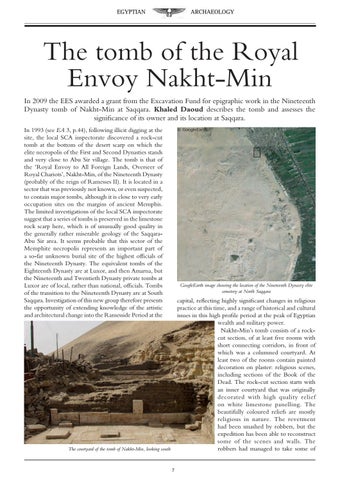
capital, reflecting highly significant changes in religious practice at this time, and a range of historical and cultural issues in this high profile period at the peak of Egyptian wealth and military power. Nakht-Min’s tomb consists of a rockcut section, of at least five rooms with short connecting corridors, in front of which was a columned courtyard. At least two of the rooms contain painted decoration on plaster: religious scenes, including sections of the Book of the Dead. The rock-cut section starts with an inner courtyard that was originally decorated with high quality relief on white limestone panelling. The beautifully coloured reliefs are mostly religious in nature. The revetment had been smashed by robbers, but the expedition has been able to reconstruct some of the scenes and walls. The robbers had managed to take some of
The courtyard of the tomb of Nakht-Min, looking south