EGYPTIAN
ARCHAEOLOGY
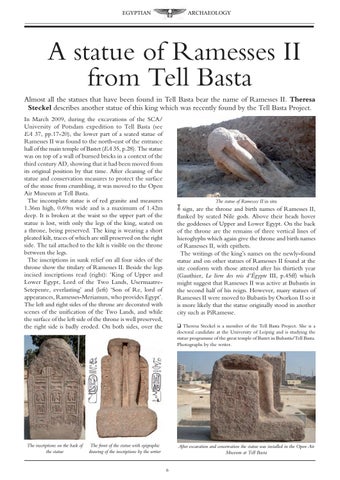
A statue of Ramesses II from Tell Basta Almost all the statues that have been found in Tell Basta bear the name of Ramesses II. Theresa Steckel describes another statue of this king which was recently found by the Tell Basta Project. In March 2009, during the excavations of the SCA/ University of Potsdam expedition to Tell Basta (see EA 37, pp.17-20), the lower part of a seated statue of Ramesses II was found to the north-east of the entrance hall of the main temple of Bastet (EA 35, p.28). The statue was on top of a wall of burned bricks in a context of the third century AD, showing that it had been moved from its original position by that time. After cleaning of the statue and conservation measures to protect the surface of the stone from crumbling, it was moved to the Open Air Museum at Tell Basta. The incomplete statue is of red granite and measures 1.36m high, 0.69m wide and is a maximum of 1.42m deep. It is broken at the waist so the upper part of the statue is lost, with only the legs of the king, seated on a throne, being preserved. The king is wearing a short pleated kilt, traces of which are still preserved on the right side. The tail attached to the kilt is visible on the throne between the legs. The inscriptions in sunk relief on all four sides of the throne show the titulary of Ramesses II. Beside the legs incised inscriptions read (right): ‘King of Upper and Lower Egypt, Lord of the Two Lands, UsermaatreSetepenre, everlasting’ and (left) ‘Son of Re, lord of appearances, Ramesses-Meriamun, who provides Egypt’. The left and right sides of the throne are decorated with scenes of the unification of the Two Lands, and while the surface of the left side of the throne is well preserved, the right side is badly eroded. On both sides, over the
The inscriptions on the back of the statue
The statue of Ramesses II in situ
sign, are the throne and birth names of Ramesses II, flanked by seated Nile gods. Above their heads hover the goddesses of Upper and Lower Egypt. On the back of the throne are the remains of three vertical lines of hieroglyphs which again give the throne and birth names of Ramesses II, with epithets. The writings of the king’s names on the newly-found statue and on other statues of Ramesses II found at the site conform with those attested after his thirtieth year (Gauthier, Le livre des rois d’Égypte III, p.45ff) which might suggest that Ramesses II was active at Bubastis in the second half of his reign. However, many statues of Ramesses II were moved to Bubastis by Osorkon II so it is more likely that the statue originally stood in another city such as PiRamesse. q Theresa Steckel is a member of the Tell Basta Project. She is a doctoral candidate at the University of Leipzig and is studying the statue programme of the great temple of Bastet in Bubastis/Tell Basta. Photographs by the writer.
The front of the statue with epigraphic drawing of the inscriptions by the writer
After excavation and conservation the statue was installed in the Open Air Museum at Tell Basta