The Egypt Exploration Society Recent Publications E E S
E X C AVAT I O N
M E M O I R
9 6
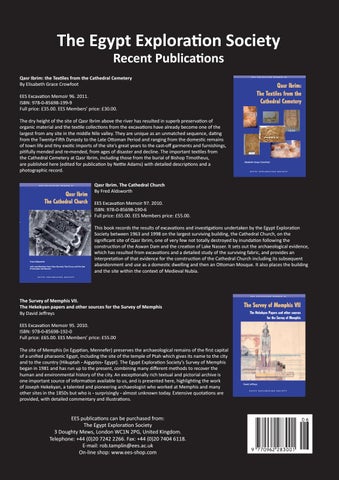
Qasr Ibrim: The Textiles from the Cathedral Cemetery
EES Excavation Memoir 96. 2011. ISBN: 978-0-85698-199-9 Full price: £35.00. EES Members’ price: £30.00.
The dry height of the site of Qasr Ibrim above the river has resulted in superb preservation of organic material and the textile collections from the excavations have already become one of the largest from any site in the middle Nile valley. They are unique as an unmatched sequence, dating from the Twenty-Fifth Dynasty to the Late Ottoman Period and ranging from the domestic remains of town life and tiny exotic imports of the site’s great years to the cast-off garments and furnishings, pitifully mended and remended, from ages of disaster and decline. The important textiles from the cemeteray at Qasr irbim, including those from the burial of Bishop Timotheus are published here with detailed descriptions and a photographic record of the most significant pieces.
Elisabeth Grace Crowfoot was an expert on ancient textiles and in 1976 she was invited to join the Egypt Exploration Society’s expedition to Qasr Ibrim, after having worked in Cambridge on textiles from seasons in the 1960s. She worked with the expedition until 1984, sorting, washing and cataloguing textiles as they were excavated, assisted
in the field by Nettie Adams. Miss Crowfoot had completed this text before her death in 2005 and it has been edited for publication by Nettie Adams.
M E M O I R
9 7
E E S
Qasr Ibrim. The Cathedral Church
Ibrim dral Church
s and ration
argest n the
y few ng the
ion of dence, etailed
rchaeologist and heritage consultant with a
M E M O I R
9 7
Qasr Ibrim The Cathedral Church
Fred Aldsworth
an interpretation of that evidence for the g its subsequent abandonment and use as a
sque. It also places the building and the site
E X C AVAT I O N
e study and preservation of historic buildings to his work at Qasr Ibrim, he has also been rojects associated with the Giza Plateau and
at Berenike, Hitan Rayan, and Shenshef. In work in the UK, he has also worked in Iran,
nd Madagascar.
Fred Aldsworth with contributions from Hans Barnard, Paul Drury and the late Przemyslaw Gartkiewicz ::H :B .,
E G Y P T
E X P L O R AT I O N
E X C AVAT I O N
M E M O I R
9 6
Qasr Ibrim: The Textiles from the Cathedral Cemetery
Elisabeth Grace Crowfoot
The dry height of the site of Qasr Ibrim above the river has resulted in superb preservation of organic material and the textile collections from the excavations have already become one of the largest from any site in the middle Nile valley. They are unique as an unmatched sequence, dating from the Twenty-Fifth Dynasty to the Late Ottoman Period and ranging from the domestic remains of town life and tiny exotic imports of the site’s great years to the cast-off garments and furnishings, pitifully mended and re-mended, from ages of disaster and decline. The important textiles from the Cathedral Cemetery at Qasr Ibrim, including those from the burial of Bishop Timotheus, are published here (edited for publication by Nettie Adams) with detailed descriptions and a photographic record.
E E S
Qasr Ibrim: The Textiles from the Cathedral Cemeteray
Qasr Ibrim: the Textiles from the Cathedral Cemetery By Elisabeth Grace Crowfoot
Elisabeth Grace Crowfoot ::H :B .+
E G Y P T
E X P L O R AT I O N
S O C I E T Y
Qasr Ibrim. The Cathedral Church By Fred Aldsworth EES Excavation Memoir 97. 2010. ISBN: 978-0-85698-190-6 Full price: £65.00. EES Members price: £55.00. This book records the results of excavations and investigations undertaken by the Egypt Exploration Society between 1963 and 1998 on the largest surviving building, the Cathedral Church, on the significant site of Qasr Ibrim, one of very few not totally destroyed by inundation following the construction of the Aswan Dam and the creation of Lake Nasser. It sets out the archaeological evidence, which has resulted from excavations and a detailed study of the surviving fabric, and provides an interpretation of that evidence for the construction of the Cathedral Church including its subsequent abandonment and use as a domestic dwelling and then an Ottoman Mosque. It also places the building and the site within the context of Medieval Nubia.
S O C I E T Y
The Survey of Memphis VII. The Hekekyan papers and other sources for the Survey The Survey of Memphis VII. The Survey of Memphis VII The Hekekyan papers and other sources for the Survey of Memphis The Hekekyan Papers and other sources for the Survey of Memphis By David Jeffreys E E S
E X C AVAT I O N
M E M O I R
9 5
EES Excavation Memoir 95. 2010. ISBN: 978-0-85698-192-0 Full price: £65.00. EES Members’ price: £55.00
of the city. An exceptionally rich textual and pictorial archive is one important source of information available to us, and is presented here, highlighting the work of Joseph Hekekyan, a talented and pioneering archaeologist who worked at Memphis and many other sites in the 1850s but who is - surprisingly - almost unknown today. Extensive quotations are provided, with detailed commentary and illustrations.
The Survey of Memphis VII. The Hekekyan Papers and other sources for the Survey of Memphis
The site of Memphis (in Egyptian, Mennefer) preserves the archaeological remains of the first capital of a unified pharaonic Egypt, including the site of the temple of Ptah which gives its name to the city and to the country (Hikuptah - Aigytos - Egypt). The Egypt Exploration Society’s Survey of Memphis began in 1981 and has run up to the present, combining many different methods to recover the human and environmental history
E E S
David Jeffreys is Senior Lecturer in Egyptian Archaeology at University College London Institute of Archaeology. He gained a BA in Hebrew and Egyptian at UCL in 1975 and has worked extensively at sites in the UK (Lincoln, Caernarvon, London) and in the Middle East (Tell Nebi Mend/Qadesh and Tell Brak in Syria, Tuleilat Ghassul in Jordan, Balat (Dakhla Oasis) and Saqqara in Egypt). Since 1981 he has been successively supervisor and Field Director of the EES survey of Memphis. His PhD thesis (presented in this volume) was an external University of London degree. A professional profile and recent publications are viewable at www.ucl.ac.uk/archaeology/staff/profiles/jeffreys.htm
M E M O I R
9 5
The Survey of Memphis VII The Hekekyan Papers and other sources for the Survey of Memphis
David Jeffreys
The site of Memphis (in Egyptian, Mennefer) preserves the archaeological remains of the first capital of a unified pharaonic Egypt, including the site of the temple of Ptah which gives its name to the city and to the country (Hikuptah - Aigyptos- Egypt). The Egypt Exploration Society’s Survey of Memphis began in 1981 and has run up to the present, combining many different methods to recover the human and environmental history of the city. An exceptionally rich textual and pictorial archive is one important source of information available to us, and is presented here, highlighting the work of Joseph Hekekyan, a talented and pioneering archaeologist who worked at Memphis and many other sites in the 1850s but who is - surprisingly - almost unknown today. Extensive quotations are provided, with detailed commentary and illustrations.
E X C AVAT I O N
::H :B .*
David Jeffreys E G Y P T
E X P L O R AT I O N
S O C I E T Y
EES publications can be purchased from: The Egypt Exploration Society 3 Doughty Mews, London WC1N 2PG, United Kingdom. Telephone: +44 (0)20 7242 2266. Fax: +44 (0)20 7404 6118. E-mail: rob.tamplin@ees.ac.uk On-line shop: www.ees-shop.com
EA38 BackCover.indd 1
9/2/11 12:21:00