EGYPTIAN
ARCHAEOLOGY
Five minutes with Kent Weeks In what we intend to be the first of a new regular feature in EA we will be talking to renowned Egyptologists about their own work and their connection to the EES. Kent Weeks has been a member of the Society for many years and kindly agreed to start the series off. about engineering and conservation as it is clearing, and it necessarily goes slowly. Chambers 1 and 2 took over five years to clear, and we’ve been working in chamber 5 for three seasons. At this rate, we might finish work in the tomb in 2075! How has archaeology in Egypt changed during your career? Archaeology in Egypt has become a significant research tool, not simply a means of finding objects. It has matured and become as good in its methods and theories as any other archaeological field. It has become aware that the monuments of Egypt are a finite resource that must be dug with care and protected. My major concern is the Theban Necropolis. Nine thousand tourists now visit there every day. Recently, Thebes has been undergoing many changes designed to encourage even more tourists. Some of these changes have not been thought through, and I worry that the combined effects of more tourists and poor planning will shorten the life of its monuments.
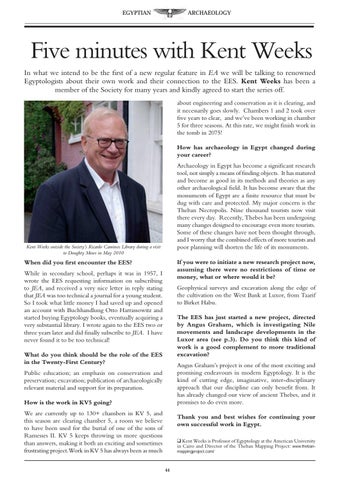
Kent Weeks outside the Society’s Ricardo Caminos Library during a visit to Doughty Mews in May 2010
If you were to initiate a new research project now, assuming there were no restrictions of time or money, what or where would it be?
When did you first encounter the EES? While in secondary school, perhaps it was in 1957, I wrote the EES requesting information on subscribing to JEA, and received a very nice letter in reply stating that JEA was too technical a journal for a young student. So I took what little money I had saved up and opened an account with Buchhandlung Otto Harrassowitz and started buying Egyptology books, eventually acquiring a very substantial library. I wrote again to the EES two or three years later and did finally subscribe to JEA. I have never found it to be too technical!
Geophysical surveys and excavation along the edge of the cultivation on the West Bank at Luxor, from Taarif to Birket Habu. The EES has just started a new project, directed by Angus Graham, which is investigating Nile movements and landscape developments in the Luxor area (see p.3). Do you think this kind of work is a good complement to more traditional excavation?
What do you think should be the role of the EES in the Twenty-First Century?
Angus Graham’s project is one of the most exciting and promising endeavours in modern Egyptology. It is the kind of cutting edge, imaginative, inter-disciplinary approach that our discipline can only benefit from. It has already changed our view of ancient Thebes, and it promises to do even more.
Public education; an emphasis on conservation and preservation; excavation; publication of archaeologically relevant material and support for its preparation. How is the work in KV5 going? We are currently up to 130+ chambers in KV 5, and this season are clearing chamber 5, a room we believe to have been used for the burial of one of the sons of Ramesses II. KV 5 keeps throwing us more questions than answers, making it both an exciting and sometimes frustrating project.Work in KV 5 has always been as much
Thank you and best wishes for continuing your own successful work in Egypt. q Kent Weeks is Professor of Egyptology at the American University in Cairo and Director of the Theban Mapping Project: www.theban-
mappingproject.com/
44