EGYPTIAN
ARCHAEOLOGY
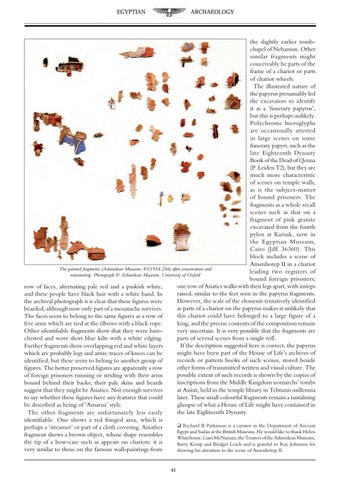
the slightly earlier tombchapel of Nebamun. Other similar fragments might conceivably be parts of the frame of a chariot or parts of chariot wheels. The illustrated nature of the papyrus presumably led the excavators to identify it as a ‘funerary papyrus’, but this is perhaps unlikely. Polychrome hieroglyphs are occasionally attested in large scenes on some funerary papyri, such as the late Eighteenth Dynasty Book of the Dead of Qenna (P. Leiden T2), but they are much more characteristic of scenes on temple walls, as is the subject-matter of bound prisoners. The fragments as a whole recall scenes such as that on a fragment of pink granite excavated from the fourth pylon at Karnak, now in the Egyptian Museum, Cairo (JdE 36360). This block includes a scene of Amenhotep II in a chariot The painted fragments (Ashmolean Museum AN1934.266) after conservation and leading two registers of remounting. Photograph © Ashmolean Museum, University of Oxford bound foreign prisoners; one row of Asiatics walks with their legs apart, with insteps row of faces, alternating pale red and a pinkish white, raised, similar to the feet seen in the papyrus fragments. and these people have black hair with a white band. In However, the scale of the elements tentatively identified the archival photograph it is clear that these figures were as parts of a chariot on the papyrus makes it unlikely that bearded, although now only part of a moustache survives. this chariot could have belonged to a large figure of a The faces seem to belong to the same figures as a row of king, and the precise contents of the composition remain five arms which are tied at the elbows with a black rope. very uncertain. It is very possible that the fragments are Other identifiable fragments show that they were bareparts of several scenes from a single roll. chested and wore short blue kilts with a white edging. If the description suggested here is correct, the papyrus Further fragments show overlapping red and white layers might have been part of the House of Life’s archives of which are probably legs and arms; traces of knees can be records or pattern books of such scenes, stored beside identified, but these seem to belong to another group of other forms of transmitted written and visual culture. The figures. The better preserved figures are apparently a row possible extent of such records is shown by the copies of of foreign prisoners running or striding with their arms inscriptions from the Middle Kingdom nomarchs’ tombs bound behind their backs; their pale skins and beards at Assiut, held in the temple library in Tebtunis millennia suggest that they might be Asiatics. Not enough survives later. These small colourful fragments remain a tantalising to say whether these figures have any features that could glimpse of what a House of Life might have contained in be described as being of ‘Amarna’ style. the late Eighteenth Dynasty. The other fragments are unfortunately less easily identifiable. One shows a red fringed area, which is q Richard B Parkinson is a curator in the Department of Ancient perhaps a ‘streamer’ or part of a cloth covering. Another Egypt and Sudan at the British Museum. He would like to thank Helen fragment shows a brown object, whose shape resembles Whitehouse, Liam McNamara, the Trustees of the Ashmolean Museum, the tip of a bow-case such as appears on chariots: it is Barry Kemp and Bridget Leach and is grateful to Ray Johnston for very similar to those on the famous wall-paintings from drawing his attention to the scene of Amenhotep II. 43