EGYPTIAN
ARCHAEOLOGY
A papyrus from the House of Life at Akhetaten
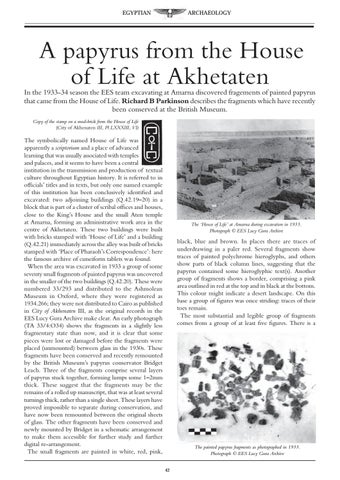
In the 1933-34 season the EES team excavating at Amarna discovered fragements of painted papyrus that came from the House of Life. Richard B Parkinson describes the fragments which have recently been conserved at the British Museum. Copy of the stamp on a mud-brick from the House of Life (City of Akhenaten III, Pl.LXXXIII, VI)
The symbolically named House of Life was apparently a scriptorium and a place of advanced learning that was usually associated with temples and palaces, and it seems to have been a central institution in the transmission and production of textual culture throughout Egyptian history. It is referred to in officials’ titles and in texts, but only one named example of this institution has been conclusively identified and excavated: two adjoining buildings (Q.42.19–20) in a block that is part of a cluster of scribal offices and houses, close to the King’s House and the small Aten temple at Amarna, forming an administrative work area in the centre of Akhetaten. These two buildings were built with bricks stamped with ‘House of Life’ and a building (Q.42.21) immediately across the alley was built of bricks stamped with ‘Place of Pharaoh’s Correspondence’: here the famous archive of cuneiform tablets was found. When the area was excavated in 1933 a group of some seventy small fragments of painted papyrus was uncovered in the smaller of the two buildings (Q.42.20). These were numbered 33/293 and distributed to the Ashmolean Museum in Oxford, where they were registered as 1934.266; they were not distributed to Cairo as published in City of Akhenaten III, as the original records in the EES Lucy Gura Archive make clear. An early photograph (TA 33/4:O34) shows the fragments in a slightly less fragmentary state than now, and it is clear that some pieces were lost or damaged before the fragments were placed (unmounted) between glass in the 1930s. These fragments have been conserved and recently remounted by the British Museum’s papyrus conservator Bridget Leach. Three of the fragments comprise several layers of papyrus stuck together, forming lumps some 1–2mm thick. These suggest that the fragments may be the remains of a rolled up manuscript, that was at least several turnings thick, rather than a single sheet. These layers have proved impossible to separate during conservation, and have now been remounted between the original sheets of glass. The other fragments have been conserved and newly mounted by Bridget in a schematic arrangement to make them accessible for further study and further digital re-arrangement. The small fragments are painted in white, red, pink,
The ‘House of Life’ at Amarna during excavation in 1933. Photograph © EES Lucy Gura Archive
black, blue and brown. In places there are traces of underdrawing in a paler red. Several fragments show traces of painted polychrome hieroglyphs, and others show parts of black column lines, suggesting that the papyrus contained some hieroglyphic text(s). Another group of fragments shows a border, comprising a pink area outlined in red at the top and in black at the bottom. This colour might indicate a desert landscape. On this base a group of figures was once striding: traces of their toes remain. The most substantial and legible group of fragments comes from a group of at least five figures. There is a
The painted papyrus fragments as photographed in 1933. Photograph © EES Lucy Gura Archive 42