EGYPTIAN
ARCHAEOLOGY
Fragment of a cuneiform letter found in the well of the Hyksos palace, dating to the last decades of the Old Babylonian Kingdom (by Manfred Bietak and Irene Forstner-Müller, Egypt and the Levant 2009, figs 21-22, with drawing by Frans van Koppen)
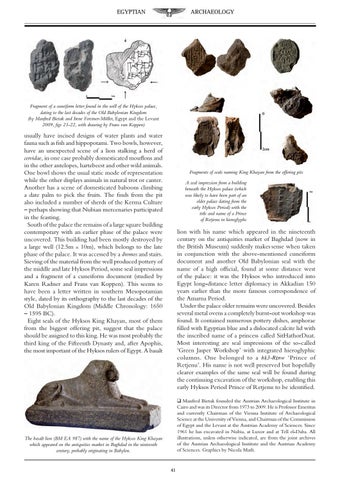
usually have incised designs of water plants and water fauna such as fish and hippopotami. Two bowls, however, have an unexpected scene of a lion stalking a herd of cervidae, in one case probably domesticated mouflons and in the other antelopes, hartebeest and other wild animals. One bowl shows the usual static mode of representation while the other displays animals in natural trot or canter. Another has a scene of domesticated baboons climbing a date palm to pick the fruits. The finds from the pit also included a number of sherds of the Kerma Culture – perhaps showing that Nubian mercenaries participated in the feasting. South of the palace the remains of a large square building contemporary with an earlier phase of the palace were uncovered. This building had been mostly destroyed by a large well (12.5m x 10m), which belongs to the late phase of the palace. It was accessed by a dromos and stairs. Sieving of the material from the well produced pottery of the middle and late Hyksos Period, some seal impressions and a fragment of a cuneiform document (studied by Karen Radner and Frans van Koppen). This seems to have been a letter written in southern Mesopotamian style, dated by its orthography to the last decades of the Old Babylonian Kingdom (Middle Chronology: 1650 – 1595 BC). Eight seals of the Hyksos King Khayan, most of them from the biggest offering pit, suggest that the palace should be assigned to this king. He was most probably the third king of the Fifteenth Dynasty and, after Apophis, the most important of the Hyksos rulers of Egypt. A basalt
Fragments of seals naming King Khayan from the offering pits A seal impression from a building beneath the Hyksos palace (which was likely to have been part of an older palace dating from the early Hyksos Period) with the title and name of a Prince of Retjenu in hieroglyphs
lion with his name which appeared in the nineteenth century on the antiquities market of Baghdad (now in the British Museum) suddenly makes sense when taken in conjunction with the above-mentioned cuneiform document and another Old Babylonian seal with the name of a high official, found at some distance west of the palace: it was the Hyksos who introduced into Egypt long-distance letter diplomacy in Akkadian 150 years earlier than the more famous correspondence of the Amarna Period. Under the palace older remains were uncovered. Besides several metal ovens a completely burnt-out workshop was found. It contained numerous pottery dishes, amphorae filled with Egyptian blue and a dislocated calcite lid with the inscribed name of a princess called SitHathorDuat. Most interesting are seal impressions of the so-called ‘Green Jasper Workshop’ with integrated hieroglyphic columns. One belonged to a hq3-Rṯnw ‘Prince of Retjenu’. His name is not well preserved but hopefully clearer examples of the same seal will be found during the continuing excavation of the workshop, enabling this early Hyksos Period Prince of Retjenu to be identified. q Manfred Bietak founded the Austrian Archaeological Institute in Cairo and was its Director from 1973 to 2009. He is Professor Emeritus and currently Chairman of the Vienna Institute of Archaeological Science at the University of Vienna, and Chairman of the Commission of Egypt and the Levant at the Austrian Academy of Sciences. Since 1961 he has excavated in Nubia, at Luxor and at Tell el-Daba. All illustrations, unless otherwise indicated, are from the joint archives of the Austrian Archaeological Institute and the Austrian Academy of Sciences. Graphics by Nicola Math.
The basalt lion (BM EA 987) with the name of the Hyksos King Khayan which appeared on the antiquities market in Baghdad in the ninteenth century, probably originating in Babylon. 41