EGYPTIAN
ARCHAEOLOGY
One of the ceremonial fish bowls with representations of a lion stalking herds of both domesticated and wild animals
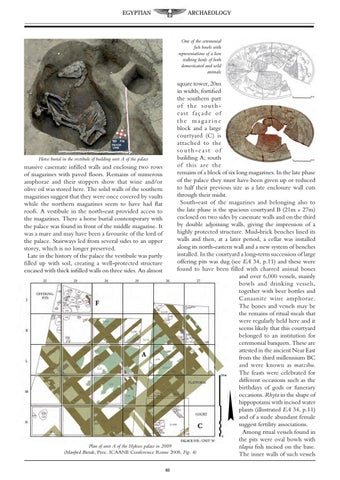
square tower, 20m in width, fortified the southern part of the southeast faรงade of the magazine block and a large courtyard (C) is attached to the south-east of building A; south Horse burial in the vestibule of building unit A of the palace of this are the massive casemate infilled walls and enclosing two rows remains of a block of six long magazines. In the late phase of magazines with paved floors. Remains of numerous of the palace they must have been given up or reduced amphorae and their stoppers show that wine and/or to half their previous size as a late enclosure wall cuts olive oil was stored here. The solid walls of the southern through their midst. magazines suggest that they were once covered by vaults South-east of the magazines and belonging also to while the northern magazines seem to have had flat the late phase is the spacious courtyard B (21m x 27m) roofs. A vestibule in the north-east provided access to enclosed on two sides by casemate walls and on the third the magazines. There a horse burial contemporary with by double adjoining walls, giving the impression of a the palace was found in front of the middle magazine. It highly protected structure. Mud-brick benches lined its was a mare and may have been a favourite of the lord of walls and then, at a later period, a cellar was installed the palace. Stairways led from several sides to an upper along its north-eastern wall and a new system of benches storey, which is no longer preserved. installed. In the courtyard a long-term succession of large Late in the history of the palace the vestibule was partly offering pits was dug (see EA 34, p.11) and these were filled up with soil, creating a well-protected structure found to have been filled with charred animal bones encased with thick infilled walls on three sides. An almost and over 6,000 vessels, mainly bowls and drinking vessels, together with beer bottles and Canaanite wine amphorae. The bones and vessels may be the remains of ritual meals that were regularly held here and it seems likely that this courtyard belonged to an institution for ceremonial banquets. These are attested in the ancient Near East from the third millennium BC and were known as marzihu. The feasts were celebrated for different occasions such as the birthdays of gods or funerary occasions. Rhyta in the shape of hippopotami with incised water plants (illustrated EA 34, p.11) and of a nude abundant female suggest fertility associations. Among ritual vessels found in the pits were oval bowls with Plan of unit A of the Hyksos palace in 2009 tilapia fish incised on the base. (Manfred Bietak, Proc. ICAANE Conference Rome 2008, Fig. 4) The inner walls of such vessels 40