EGYPTIAN
ARCHAEOLOGY
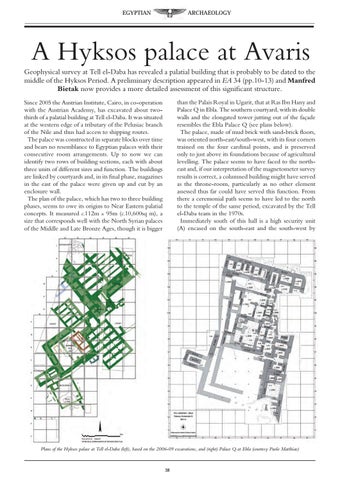
A Hyksos palace at Avaris Geophysical survey at Tell el-Daba has revealed a palatial building that is probably to be dated to the middle of the Hyksos Period. A preliminary description appeared in EA 34 (pp.10-13) and Manfred Bietak now provides a more detailed assessment of this significant structure. than the Palais Royal in Ugarit, that at Ras Ibn Hany and Palace Q in Ebla. The southern courtyard, with its double walls and the elongated tower jutting out of the faรงade resembles the Ebla Palace Q (see plans below). The palace, made of mud brick with sand-brick floors, was oriented north-east/south-west, with its four corners trained on the four cardinal points, and is preserved only to just above its foundations because of agricultural levelling. The palace seems to have faced to the northeast and, if our interpretation of the magnetometer survey results is correct, a columned building might have served as the throne-room, particularly as no other element assessed thus far could have served this function. From there a ceremonial path seems to have led to the north to the temple of the same period, excavated by the Tell el-Daba team in the 1970s. Immediately south of this hall is a high security unit (A) encased on the south-east and the south-west by
Since 2005 the Austrian Institute, Cairo, in co-operation with the Austrian Academy, has excavated about twothirds of a palatial building at Tell el-Daba. It was situated at the western edge of a tributary of the Pelusiac branch of the Nile and thus had access to shipping routes. The palace was constructed in separate blocks over time and bears no resemblance to Egyptian palaces with their consecutive room arrangements. Up to now we can identify two rows of building sections, each with about three units of different sizes and function. The buildings are linked by courtyards and, in its final phase, magazines in the east of the palace were given up and cut by an enclosure wall. The plan of the palace, which has two to three building phases, seems to owe its origins to Near Eastern palatial concepts. It measured c.112m x 95m (c.10,600sq m), a size that corresponds well with the North Syrian palaces of the Middle and Late Bronze Ages, though it is bigger
Plans of the Hyksos palace at Tell el-Daba (left), based on the 2006-09 excavations, and (right) Palace Q at Ebla (courtesy Paolo Matthiae)
38