EGYPTIAN
ARCHAEOLOGY
and within this Plot Dates, or View and Plot on curve, to see the date range on the calibration curve itself. It is also possible to plot a series of dates. The information on Association and Age at Deposition firstly confirms the likelihood that the sample relates directly to the object or context for which the date is being sought and then states how likely it is that the organic material from which the radiocarbon sample has been taken had been no longer living for 0-20 years, 0-100 years, 0-n00 years or an uncertain period, when the item was originally made, be it straw for a mud brick, papyrus for an archival document, or foodstuffs for a foundation deposit. As noted earlier, this is a particularly important piece of information, because it may help the user to interpret the radiocarbon measurement. For example, if the sample was from a fruit, then we would expect the fruit to have been picked in the same year in which it had grown, with a resultant Age at Deposition being 0-20 years. However, if the sample was from a piece of wood, then, dependent upon the longevity of the species and whether the sample was taken from the inner or outer growth rings of the tree, an Age at Deposition might range from 0-20 years up to 0-n00 years. Ultimately, this could greatly affect the relationship between the radiocarbon measurement and the context of the sample. From the screens for individual results it is also possible to click on any of the hot-linked fields (shown in blue - e.g. Country, Region, Site, Period, Dynasty, Reign) and be presented with a screen that lists all radiocarbon measurements relating to the selection. To avoid confusion associated with the variable spellings of locations and names, there is a pull-down menu at the top of the screen which allows the user to browse periods, dynasties and reigns and also countries, regions and sites, which when selected show the range of options available within the database. Bibliographic references can either be selected from an individual screen or by using the pull-down tab at the top of the main screen. Once the chosen references are displayed, it is possible to click on a chosen reference to received full bibliographic data in an additional screen, which allows the option to link to Google Scholar (http://scholar.google.co.uk/). This database is by no means exhaustive and it is very much intended to be an updatable resource. Information on how to submit additional radiocarbon results will be a future part of the website and will allow users to submit published dates that are not yet included.
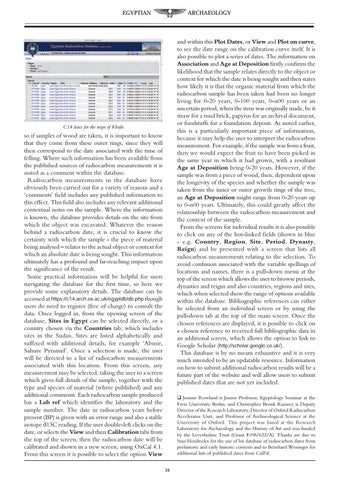
C14 dates for the reign of Khufu
so if samples of wood are taken, it is important to know that they come from these outer rings, since they will then correspond to the date associated with the time of felling. Where such information has been available from the published sources of radiocarbon measurements it is noted as a comment within the database. Radiocarbon measurements in the database have obviously been carried out for a variety of reasons and a ‘comments’ field includes any published information to this effect. This field also includes any relevant additional contextual notes on the sample. Where the information is known, the database provides details on the site from which the object was excavated. Whatever the reason behind a radiocarbon date, it is crucial to know the certainty with which the sample - the piece of material being analysed – relates to the actual object or context for which an absolute date is being sought. This information ultimately has a profound and far-reaching impact upon the significance of the result. Some practical information will be helpful for users navigating the database for the first time, so here we provide some explanatory details. The database can be accessed at https://c14.arch.ox.ac.uk/egyptdb/db.php though users do need to register (free of charge) to consult the data. Once logged in, from the opening screen of the database, Sites in Egypt can be selected directly, or a country chosen via the Countries tab, which includes sites in the Sudan. Sites are listed alphabetically and suffixed with additional details, for example ‘Abusir, Sahure Pyramid’. Once a selection is made, the user will be directed to a list of radiocarbon measurements associated with this location. From this screen, any measurement may be selected, taking the user to a screen which gives full details of the sample, together with the type and species of material (where published) and any additional comments. Each radiocarbon sample produced has a Lab ref which identifies the laboratory and the sample number. The date in radiocarbon years before present (BP) is given with an error range and also a stable isotope δ13C reading. If the user double-left clicks on the date, or selects the View and then Calibration tabs from the top of the screen, then the radiocarbon date will be calibrated and shown in a new screen, using OxCal 4.1. From this screen it is possible to select the option View
q Joanne Rowland is Junior Professor, Egyptology Seminar at the Freie University Berlin, and Christopher Bronk Ramsey is Deputy Director of the Research Laboratory, Director of Oxford Radiocarbon Accelerator Unit, and Professor of Archaeological Science at the University of Oxford. This project was based at the Research Laboratory for Archaeology and the History of Art and was funded by the Leverhulme Trust (Grant F/08/622/A). Thanks are due to Stan Hendrickx for the use of his database of radiocarbon dates from prehistoric and early historic contexts and to Bernhard Weninger for additional lists of published dates from CalPal. 34