EGYPTIAN
ARCHAEOLOGY
Online C14 database for Egypt A project at the Oxford-based Research Laboratory for Archaeology and the History of Art investigated synchronisms between Egyptian historical chronology and radiocarbon measurements taken on Egyptian material. Joanne Rowland and Christopher Bronk Ramsey discuss the project and present the resulting online database. In 2006 a project was initiated which aimed, for the first time, to examine systematically synchronisations between the historical chronology of ancient Egypt and dates obtained through radiocarbon measurements. The project concluded in summer 2009 with publication of the new radiocarbon results in Science (18 June 2010: 1554-1557) and the creation of an online database of radiocarbon measurements undertaken in the Nile Valley from the inception of radiocarbon dating by Willard F Libby in the 1950s until the present day. The resource covers prehistoric through to medieval dates run on material from sites in both Egypt and the Sudan. This corpus of dates helped to inform our own dating strategy and we hope they will be of interest to other researchers. Some of the key reasons why radiocarbon dates are run on archaeological material are: 1) to establish an absolute date for a context for which there is no known historical correlate at all (for example, a grave with no datable pottery vessels or other objects) 2) to confirm the date of an object thought to be from a specific period on stylistic grounds but with no secure archaeological context 3) to check a historical date through synchronisation with scientific dating measurements. All of the radiocarbon dates to be found at: https://c14.arch. ox.ac.uk/egyptdb/db.php come from published sources and the online facility allows this information to be accessed and presented in a number of different ways. For each radiocarbon date details are given of the archaeological context, expected historical correlates, type and species of the sample material, radiocarbon measurement with error margin, details of the museum where the object is held (where applicable and/or known), certainty of the sample coming from a specific object/context and any considerations as to the inbuilt age of a sample. Bibliographic references are also provided. Radiocarbon measurements are taken on small samples of organic material which usually range from as little as 10mg to as much as 50g, depending upon the type of technique used. A proportion of more recent dates, such as those conducted at the Oxford Radiocarbon Accelerator Unit (ORAU) for this project, are measured using Accelerated Mass Spectrometry (AMS), which can be obtained with samples at the lower end of the size scale, whereas the earlier Liquid Scintillation method requires a larger sample size. Suitable materials from Egyptian contexts include food remains (seeds, nuts and fruits), basketry, matting and sandals (made from
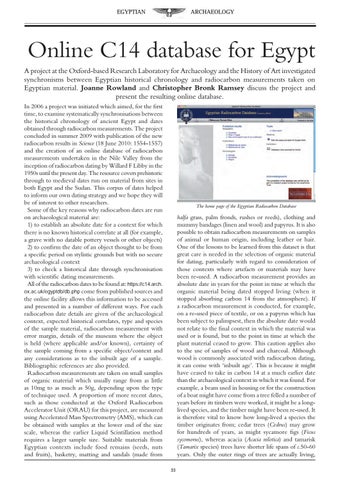
The home page of the Egyptian Radiocarbon Database
halfa grass, palm fronds, rushes or reeds), clothing and mummy bandages (linen and wool) and papyrus. It is also possible to obtain radiocarbon measurements on samples of animal or human origin, including leather or hair. One of the lessons to be learned from this dataset is that great care is needed in the selection of organic material for dating, particularly with regard to consideration of those contexts where artefacts or materials may have been re-used. A radiocarbon measurement provides an absolute date in years for the point in time at which the organic material being dated stopped living (when it stopped absorbing carbon 14 from the atmosphere). If a radiocarbon measurement is conducted, for example, on a re-used piece of textile, or on a papyrus which has been subject to palimpsest, then the absolute date would not relate to the final context in which the material was used or is found, but to the point in time at which the plant material ceased to grow. This caution applies also to the use of samples of wood and charcoal. Although wood is commonly associated with radiocarbon dating, it can come with ‘inbuilt age’. This is because it might have ceased to take in carbon 14 at a much earlier date than the archaeological context in which it was found. For example, a beam used in housing or for the construction of a boat might have come from a tree felled a number of years before its timbers were worked, it might be a longlived species, and the timber might have been re-used. It is therefore vital to know how long-lived a species the timber originates from; cedar trees (Cedrus) may grow for hundreds of years, as might sycamore figs (Ficus sycomorus), whereas acacia (Acacia nilotica) and tamarisk (Tamarix species) trees have shorter life spans of c.50-60 years. Only the outer rings of trees are actually living, 33