EGYPTIAN
ARCHAEOLOGY
Having been discovered intact, with objects in their original position, this corpus of funerary material from the Late Period tombs at Saqqara is particularly valuable for researchers. Many such objects are now in museum collections but few have secure archaeological contexts and many have been separated from their contents. With the exception of the equipment of individuals with welldocumented careers, the precise dating of funerary objects generally causes problems and the discovery of intact wellcontexted tomb groups such as those revealed in our work will assist museum curators researching unprovenanced material in their collections. The date of these tombs has yet to be determined, but they are within the era of the Thirtieth Dynasty and Ptolemaic Period. The demotic inscription of the jar found in n1A has been assigned by Michel Chauveau to the fifth-fourth centuries BC and the Aramaic papyrus fragments in the bottom of shaft n1 can be dated to the fifth century BC. It would seem that most of the coffins and mummies in our tombs are secondary burials, as Xrays of the mummies revealed bones which have been broken post-mortem due to rough handling by later burial parties. Like the Theban area at the same time, the Late Period necropolis at Saqqara suffered from a lack of space for new tombs and burials.
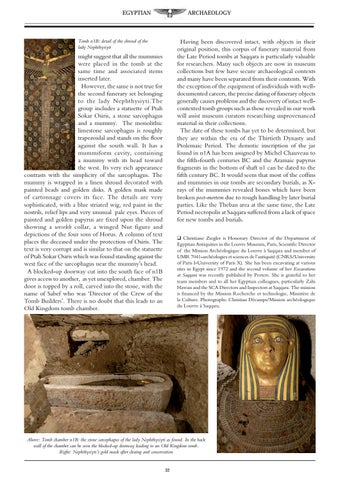
Tomb n1B: detail of the shroud of the lady Nephthysiyti
might suggest that all the mummies were placed in the tomb at the same time and associated items inserted later. However, the same is not true for the second funerary set belonging to the lady Nephthysiyti.The group includes a statuette of Ptah Sokar Osiris, a stone sarcophagus and a mummy. The monolithic limestone sarcophagus is roughly trapezoidal and stands on the floor against the south wall. It has a mummiform cavity, containing a mummy with its head toward the west. Its very rich appearance contrasts with the simplicity of the sarcophagus. The mummy is wrapped in a linen shroud decorated with painted beads and golden disks. A golden mask made of cartonnage covers its face. The details are very sophisticated, with a blue striated wig, red paint in the nostrils, relief lips and very unusual pale eyes. Pieces of painted and golden papyrus are fixed upon the shroud showing a wesekh collar, a winged Nut figure and depictions of the four sons of Horus. A column of text places the deceased under the protection of Osiris. The text is very corrupt and is similar to that on the statuette of Ptah Sokar Osiris which was found standing against the west face of the sarcophagus near the mummy’s head. A blocked-up doorway cut into the south face of n1B gives access to another, as yet unexplored, chamber. The door is topped by a roll, carved into the stone, with the name of Sabef who was ‘Director of the Crew of the Tomb Builders’. There is no doubt that this leads to an Old Kingdom tomb chamber.
q Christiane Ziegler is Honorary Director of the Department of Egyptian Antiquities in the Louvre Museum, Paris, Scientific Director of the Mission Archéologique du Louvre à Saqqara and member of UMR 7041-archéologies et sciences de l’antiquité (CNRS/University of Paris I-University of Paris X). She has been excavating at various sites in Egypt since 1972 and the second volume of her Excavations at Saqqara was recently published by Peeters. She is grateful to her team members and to all her Egyptian colleagues, particularly Zahi Hawass and the SCA Directors and Inspectors at Saqqara. The mission is financed by the Mission Recherche et technologie, Ministère de la Culture. Photographs: Christian Décamps/Mission archéologique du Louvre à Saqqara.
Above: Tomb chamber n1B: the stone sarcophagus of the lady Nephthysiyti as found. In the back wall of the chamber can be seen the blocked-up doorway leading to an Old Kingdom tomb. Right: Nephthysiyti’s gold mask after cleaing and conservation 32