EGYPTIAN
ARCHAEOLOGY
restoration the mummies and small items were transferred to the SCA storerooms. We did not open the coffins and left them inside the tomb as the Louvre Museum originally planned to continue the work in the following season. Unfortunately this has not been possible and the tomb has been closed now for several years. In the northern sector of the area excavated by the mission another shaft (n1) was discovered in 2006. This shaft, like many in the Late Period necropolis, is cut into the structure of an underlying Old Kingdom mastaba. Unusually, the shaft was entirely empty since it had been left with free access, waiting for other burials. The mouth of the shaft, covered by four slabs, was discovered cut into a kind of platform packed down and made with clayish soil, very different from the sandy layer all around. Only remains of the south wall of the shaft, built with stones and mud brick, were preserved. The cross-section of the shaft is square, 1m each side, and its depth from the slabs to the bottom is 5.70m. The base of the shaft was covered with sand and tafla chips, among which were some very small fragments of papyrus with demotic and Aramaic texts. Shaft n1 opens at its north and south ends into two symmetrical small chambers (n1A and n1B) cut into the gebel. The walls of both chambers are entirely undecorated. The northern chamber (n1A) is rectangular with two loculi and was filled to its ceiling with a spectacular heap of funerary items, carefully arranged. There was a limestone sarcophagus along the west wall, eight wooden coffins and about ten mummies. The sarcophagus and the coffins are piled on three levels. Behind the coffins and along the west wall stood a large terracotta vessel with a small cup serving as its lid. Inside were the remains of black resin and resin-soaked material. On the exterior of the vessel
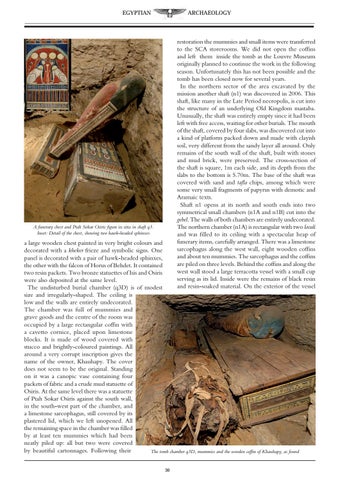
A funerary chest and Ptah Sokar Osiris figure in situ in shaft q3. Inset: Detail of the chest, showing two hawk-headed sphinxes
a large wooden chest painted in very bright colours and decorated with a kheker frieze and symbolic signs. One panel is decorated with a pair of hawk-headed sphinxes, the other with the falcon of Horus of Behdet. It contained two resin packets. Two bronze statuettes of Isis and Osiris were also deposited at the same level. The undisturbed burial chamber (q3D) is of modest size and irregularly-shaped. The ceiling is low and the walls are entirely undecorated. The chamber was full of mummies and grave goods and the centre of the room was occupied by a large rectangular coffin with a cavetto cornice, placed upon limestone blocks. It is made of wood covered with stucco and brightly-coloured paintings. All around a very corrupt inscription gives the name of the owner, Khauhapy. The cover does not seem to be the original. Standing on it was a canopic vase containing four packets of fabric and a crude mud statuette of Osiris. At the same level there was a statuette of Ptah Sokar Osiris against the south wall, in the south-west part of the chamber, and a limestone sarcophagus, still covered by its plastered lid, which we left unopened. All the remaining space in the chamber was filled by at least ten mummies which had been neatly piled up: all but two were covered by beautiful cartonnages. Following their The tomb chamber q3D, mummies and the wooden coffin of Khauhapy, as found 30