EGYPTIAN
ARCHAEOLOGY
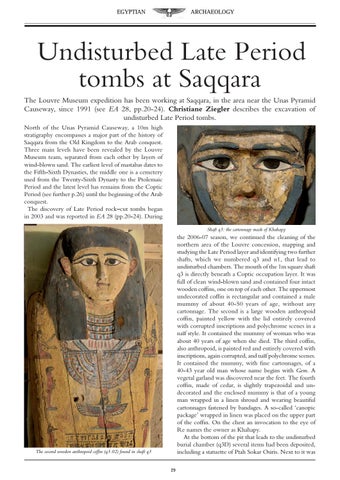
Undisturbed Late Period tombs at Saqqara The Louvre Museum expedition has been working at Saqqara, in the area near the Unas Pyramid Causeway, since 1991 (see EA 28, pp.20-24). Christiane Ziegler describes the excavation of undisturbed Late Period tombs. North of the Unas Pyramid Causeway, a 10m high stratigraphy encompasses a major part of the history of Saqqara from the Old Kingdom to the Arab conquest. Three main levels have been revealed by the Louvre Museum team, separated from each other by layers of wind-blown sand. The earliest level of mastabas dates to the Fifth-Sixth Dynasties, the middle one is a cemetery used from the Twenty-Sixth Dynasty to the Ptolemaic Period and the latest level has remains from the Coptic Period (see further p.26) until the beginning of the Arab conquest. The discovery of Late Period rock–cut tombs began in 2003 and was reported in EA 28 (pp.20-24). During Shaft q3: the cartonnage mask of Khahapy
the 2006-07 season, we continued the cleaning of the northern area of the Louvre concession, mapping and studying the Late Period layer and identifying two further shafts, which we numbered q3 and n1, that lead to undisturbed chambers. The mouth of the 1m square shaft q3 is directly beneath a Coptic occupation layer. It was full of clean wind-blown sand and contained four intact wooden coffins, one on top of each other. The uppermost undecorated coffin is rectangular and contained a male mummy of about 40-50 years of age, without any cartonnage. The second is a large wooden anthropoid coffin, painted yellow with the lid entirely covered with corrupted inscriptions and polychrome scenes in a naïf style. It contained the mummy of woman who was about 40 years of age when she died. The third coffin, also anthropoid, is painted red and entirely covered with inscriptions, again corrupted, and naïf polychrome scenes. It contained the mummy, with fine cartonnages, of a 40-43 year old man whose name begins with Gem. A vegetal garland was discovered near the feet. The fourth coffin, made of cedar, is slightly trapezoidal and undecorated and the enclosed mummy is that of a young man wrapped in a linen shroud and wearing beautiful cartonnages fastened by bandages. A so-called ‘canopic package’ wrapped in linen was placed on the upper part of the coffin. On the chest an invocation to the eye of Re names the owner as Khahapy. At the bottom of the pit that leads to the undisturbed burial chamber (q3D) several items had been deposited, including a statuette of Ptah Sokar Osiris. Next to it was
The second wooden anthropoid coffin (q3.02) found in shaft q3 29