EGYPTIAN
El-Sheikh Ibada (Antinoopolis): The season of excavation by the mission directed by Rosario Pintaudi (Istituto Papirologico «G. Vitelli», Univ of Florence) concentrated mainly on the reexamination of the church at the so-called E gate of the town, excavated in 1966 by Sergio Donadoni and his team. The missing apse of the church, or at least its foundation, which the team had hoped to identify, no longer exists due to the unusual building method of the church. It was, however, shown that this church was also provided with a forechoir in front of the apse, as was the case with the two other churches, D2 and D3, in the S part of the town. It was situated directly above the crypt at the E end of the nave. Pottery finds from below the pavement show that the church is to be dated to the early fifth century and was destroyed during the Persian invasion, c.AD 620. Below the floor of the church several undisturbed private burials were discovered, dating from the seventh and eighth centuries and later. Members of the mission also produced a new plan of the Deir Sumbat, a building complex situated in the area of the quarries N of Antinoopolis, which resembles a police camp rather than a monastery and would have served as accommodation for the soldiers who were controlling the work in the quarry. Sohag: Conservation of wall paintings in the triconch sanctuary continued at the monastic church of Saints Bigol and Bishai (the Red Monastery) by an ARCE team directed by Elizabeth Bolman and funded by USAID under the EACP grant. The Italian conservation team focused on the late antique paintings in the E apse and on a medieval painting on the N wall of what was originally part of the nave. The semi-dome over the E apse presents particular difficulties because differential losses of plaster layers have caused four successive layers of paintings to be exposed together thus creating a stylistic and thematic mosaic. Within this complex stratigraphy is a broad exposure of some of the earliest figurative paintings in the church preserved in the form of the artists’ preliminary drawings and dating to the sixth century. http://arce. org/expeditions/currentexpeditions/allexpeditions/u84
Koptos: The Univ Lyon 2/IFAO expedition, led by Laure Pantalacci, completed excavation of the section of the S Ptolemaic enclosure wall to the SE corner of the temple of Min and Isis, and a large E-W doorway was recognised. S of the door the wall is completely destroyed. The wall was directly founded on MK-SIP remains, featuring a well-built wall (2.40m wide) and silos. At the W of the site, in the baptistery area, finely carved blocks from a monument of Ptolemy IX Soter II, showing ritual scenes with Min, Isis, Osiris, and Horus/Harpocrates, were recorded. They had been reused in a square structure, presumably of the Late Roman Period. To date, this is the first attestation of Ptolemy IX in Koptos. The restoration team succeeded in re-erecting the door-jambs (2.8m high) of three monumental doorways, two of them preserved up to the lintel and cornice. www.ifao.egnet.net/archeologie/coptos/ Wadi Hammamat: The first archaeological survey for over 50 years of the ancient greywacke quarries was undertaken by a multi-disciplinary team, directed by Elizabeth Bloxam (Monash Univ), headed by the Inst of Archaeology, UCL and in co-operation with the SCA Ancient Quarries and Mines Dept. The key objectives were to map the large number of inscriptions into the ancient quarry landscape and to identify the earliest phases of greywacke quarrying linked with the production of early palettes, such as that of Narmer. Four hitherto unknown ED quarries for the production of palettes and bowls were located at high elevations on the ‘Beken Mountain’, suggesting a connection with objects found in the 1st Dyn royal funerary complexes at Abydos. Fire-setting in extracting greywacke
ARCHAEOLOGY
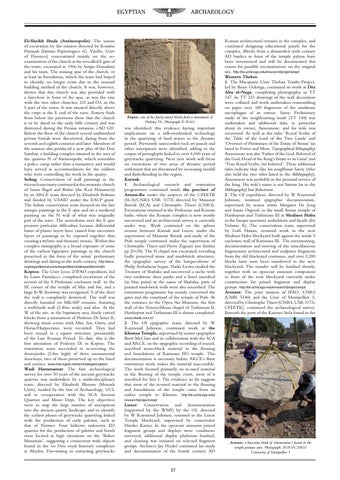
Koptos: one of the finely-carved blocks from a monument of Ptolemy IX. Photograph © IFAO
was identified; this evidence having important implications on a still-overlooked technology in the quarrying of hard stones in the dynastic period. Previously unrecorded rock art panels and other inscriptions were identified, adding to the corpus of petroglyphs linked to over 4,000 years of greywacke quarrying. Next year work will focus on excavation of two areas of dynastic period settlement that are threatened by increasing rainfall and flash-flooding in the region. Karnak: 1. Archaeological research and restoration programmes continued inside the precinct of Amun-Re under the auspices of the CFEETK (SCA/CNRS USR 3172) directed by Mansour Boreik (SCA) and Christophe Thiers (CNRS). Excavations resumed at the Ptolemaic and Roman baths, where the Roman complex is now mostly uncovered and an architectural survey is currently under way. Work continued on the sphinx avenue between Karnak and Luxor, under the supervision of Mansour Boraik and study of the Ptah temple continued under the supervision of Christophe Thiers and Pierre Zignani (see further pp.20-24). The N chapel was excavated, revealing badly preserved stone and mud-brick structures. An epigraphic survey of the barque-shrine of Philip Arrhidaeus began. Nadia Licitra studied the Treasury of Shabaka and uncovered a niche with two sandstone door jambs and a lintel inscribed (in blue paint) in the name of Shabaka; parts of painted mud-brick walls were also unearthed. The restoration programme has mainly concerned the gates and the courtyard of the temple of Ptah. At the entrance to the Open Air Museum, the first wall of the Netery-Menu chapel of Tuthmosis II, Hatshepsut and Tuthmosis III is almost completed.
Roman architectural remains in the complex, and continued designing educational panels for the complex. Blocks from a dismantled sixth century AD basilica in front of the temple pylons have been inventoried and will be documented this season for possible reconstruction on the original site. http://oi.uchicago.edu/research/projects/epi/ Western Thebes: 1. The Macquarie Univ Theban Tombs Project, led by Boyo Ockinga, continued its work at Dra Abu el-Naga, completing photography in TT 147. In TT 233 drawings of the wall decoration were collated and work undertaken reassembling on paper over 180 fragments of the sandstone sarcophagus of its owner, Saroy. Preliminary study of the neighbouring tomb (TT 149) was undertaken and additional data, in particular about its owner, Amenmose, and his wife was recovered. As well as the titles ‘Royal Scribe of the Table of the Lord of the Two Lands’ and ‘Overseer of Huntsmen of the Estate of Amun’ (as listed in Porter and Moss, Topographical Biliography) Amenmose was also ‘Father of the God, Beloved of the God; Head of the King’s Estate to its Limit’ and ‘True Royal Scribe, his beloved’. These additional titles indicate that, like his neighbour Saroy (who also held the two titles listed in the Bibilography), Amenmose was probably in the personal service of the king. His wife’s name is not Sitmut (as in the Bibliography) but Baketmut. 2. The OI expedition, directed by W Raymond Johnson, resumed epigraphic documentation, supervised by senior artists Margaret De Jong and Susan Osgood, in the small Amun temple of Hatshepsut and Tuthmosis III at Medinet Habu in the barque sanctuary ambulatory and façade (for Volume X). The conservation team, supervised by Lotfi Hassan, resumed work in the new Medinet Habu blockyard built against the inside S enclosure wall of Ramesses III. The inventorying, documentation and moving of the miscellaneous fragmentary architectural and sculpture fragments from the old blockyard continues, and over 2,200 blocks have now been transferred to the new blockyard. The transfer will be finished shortly, together with an open-air museum component in front of the new blockyard currently under construction for joined fragment and display groups. http://oi.uchicago.edu/research/projects/epi/ Armant: The joint mission of IFAO, CNRS (UMR 5140) and the Univ of Montpellier 3, directed by Christophe Thiers (CNRS, USR 3172CFEETK), continued the archaeological survey. Beneath the parts of the Kamose Stela found in the
www.cfeetk.cnrs.fr/
2. The OI epigraphic team, directed by W Raymond Johnson, continued work at the Khonsu Temple, supervised by senior epigrapher Brett McClain and in collaboration with the SCA and ARCE, on the epigraphic recording of reused, inscribed stone-block material in the flooring and foundations of Ramesses III’s temple. This documentation is necessary before ARCE’s floor restoration work makes the material inaccessible. The work focused primarily on re-used material in the flooring of the temple court, most of it inscribed for Seti I. The evidence so far suggests that most of the re-used material in the flooring and foundations of the temple came from an earlier temple to Khonsu. http://oi.uchicago.edu/ research/projects/epi/
Luxor: Conservation and documentation (supported by the WMF) by the OI, directed by W Raymond Johnson, resumed in the Luxor Temple blockyard, supervised by conservator Hiroko Kariya. In the open-air museum joined fragment groups and displays were conditionsurveyed, additional display platforms finished, and cleaning was initiated on selected fragment groups. Architect Jay Heidel continued his study and documentation of the fourth century AD
27
Armant: a limestone block of Amenemhat I found in the temple pronaos area. Photograph: IFAO/CNRS/ University of Montpellier 3