EGYPTIAN
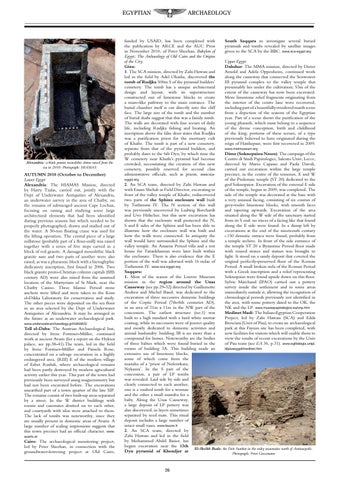
Alexandria: a black granite monolithic shrine raised from the sea in 2010. Photograph: HIAMAS
AUTUMN 2010 (October to December) Lower Egypt Alexandria: The HIAMAS Mission, directed by Harry Tzalas, carried out, jointly with the Dept of Underwater Antiquities of Alexandria, an underwater survey in the area of Chatby, on the remains of submerged ancient Cape Lochias, focusing on raising and studying some large architectural elements that had been identified during previous seasons but which needed to be properly photographed, drawn and studied out of the water. A 50-ton floating crane was used for the lifting operation. The central piece of a large millstone (probably part of a flour-mill) was raised together with a series of five steps carved in a block of red granite. A damaged monolithic black granite naos and two parts of another were also raised, as was a pharaonic block with a hieroglyphic dedicatory inscription, first found in 2006. Two black granite proto-Christian column capitals (fifth century AD) were also raised from the assumed location of the Martyrium of St Mark, near the Chatby Casino. Three Islamic Period stone anchors were lifted and were taken to the Kom el-Dikka Laboratory for conservation and study. The other pieces were deposited on the sea floor in an area selected by the Dept of Underwater Antiquities of Alexandria. It may be arranged in the future as an underwater archaeological park. www.underwaterarchaeology.gr/HIAMAS/
Tell el-Daba: The Austrian Archaeological Inst, directed by Irene Forstner-Müller, continued work at ancient Avaris (for a report on the Hyksos palace, see pp.38-41).The team, led in the field by Irene Forstner-Müller and Pamela Rose, concentrated on a salvage excavation in a highly endangered area, (RIII) E of the modern village of Ezbet Rushdi, where archaeological remains had been partly destroyed by modern agricultural activity earlier this year. This part of the town had previously been surveyed using magnetometry but had not been excavated before. The excavations unearthed part of a town quarter of the late SIP. The remains consist of two built-up areas separated by a street. In the W district buildings with rooms and casemates abutted on to each other, and courtyards with silos were attached to them. The lack of tombs was noteworthy, since they are usually present in domestic areas of Avaris. A large number of sealing impressions suggests that this town precinct had an official character. www. auaris.at
Cairo: The archaeological monitoring project, led by Peter Sheehan, in connection with the groundwater-lowering project at Old Cairo,
ARCHAEOLOGY
funded by USAID, has been completed with the publication by ARCE and the AUC Press in November 2010, of Peter Sheehan, Babylon of Egypt; The Archaeology of Old Cairo and the Origins of the City. Giza: 1. The SCA mission, directed by Zahi Hawass and led in the field by Adel Okasha, discovered the tomb of Rudjka 500m S of the pyramid builders’ cemetery. The tomb has a unique architectural design and layout, with its superstructure constructed out of limestone blocks to create a maze-like pathway to the main entrance. The burial chamber itself is cut directly into the cliff face. The large size of the tomb and the number of burial shafts suggest that this was a family tomb. The walls are decorated with fine scenes of daily life, including Rudjka fishing and boating. An inscription above the false door states that Rudjka was a purification priest for the mortuary cult of Khafre. The tomb is part of a new cemetery, separate from that of the pyramid builders, and probably dates to the 6th Dyn, by which time the W cemetery near Khufu’s pyramid had become crowded, necessitating the creation of this new cemetery, possibly reserved for second class administrative officials, such as priests. www.scaegypt.org
South Saqqara to investigate several buried pyramids and tombs revealed by satellite images given to the SCA by the BBC. www.sca-egypt.org Upper Egypt Dahshur: The MMA mission, directed by Dieter Arnold and Adela Oppenheim, continued work along the causeway that connected the Senwosret III pyramid complex to the valley temple that presumably lies under the cultivation; 53m of the extent of the causeway has now been excavated. More limestone relief fragments originating from the interior of the centre lane were recovered, including part of a beautifully-rendered marsh scene from a depiction of the seasons of the Egyptian year. Part of a scene shows the purification of the young pharaoh, which must belong to a sequence of the divine conception, birth and childhood of the king; portions of these scenes, of a type previously believed to have originated during the reign of Hatshepsut, were first recovered in 2009. www.metmuseum.org
Dime (Soknopaiou Nesos): The campaign of the Centro di Studi Papirologici, Salento Univ, Lecce, directed by Mario Capasso and Paola Davoli, carried out excavation within the large temple precinct, in the centre of the temenos, E and W of the Ptolemaic temple (ST 20) dedicated to the god Soknopaios. Excavation of the external E side of the temple, begun in 2009, was completed. The side of the temple was decorated at the base with a very unusual facing, consisting of six courses of grey-violet limestone blocks, with smooth faces and tapering upwards. Excavation of the area situated along the W side of the sanctuary started from its S end: no traces of a facing like that found along the E side were found. In a dump left by excavations at the end of the nineteenth century c.150 demotic ostraca were found, probably from a temple archive. In front of the side entrance of the temple ST 20 a Byzantine Period floor made with reused stones and statues was brought to light. It stood on a sandy deposit that covered the original perfectly-preserved floor of the Roman Period. A small broken stela of the Roman Period with a Greek inscription and a relief representing Soknopaios were found upside down on this floor. Sylvie Marchand (IFAO) carried out a pottery survey inside the settlement and in some areas immediately outside it, allowing the recognition of chronological periods previously not identified in the area, with some pottery dated to the OK, the NK and the LP. www.museopapirologico.eu/snp.htm Medinet Madi: The Italian-Egyptian Cooperation Project, led by Zahi Hawass (SCA) and Edda Bresciani (Univ of Pisa), to create an archaeological park at this Fayum site has been completed, with new facilities for visitors which will enable them to view the results of recent excavations by the Univ of Pisa team (see EA 36, p.31). www.egittologia.unipi.
2. An SCA team, directed by Zahi Hawass and with Essam Shehab as Field Director, excavating in front of the valley temple of Khafre, rediscovered two parts of the Sphinx enclosure wall built by Tuthmosis IV. The N section of this wall was previously uncovered by Ludwig Borchardt and Uvo Hölscher, but this new excavation has shown that the enclosure wall protected the N, S and E sides of the Sphinx and has been able to illustrate how the enclosure wall was built and how the walls were connected. In antiquity the wall would have surrounded the Sphinx and the valley temple. An Amarna Period villa and a rest house for Tutankhamun were later built within the enclosure. There is also evidence that the E portion of the wall was adorned with 16 stelae of Tuthmosis IV. www.sca-egypt.org Saqqara: 1. Most of the season of the Louvre Museum mission in the region around the Unas Causeway (see pp.29-32) directed by Guillemette Andreu and Michel Baud, was dedicated to the excavation of three successive domestic buildings of the Coptic Period (7th-8th centuries AD), in an area of 21m x 11m in the NW part of the concession. The earliest structure (no.1) was built to a high standard with a hard white mortar coating, while its successors were of poorer quality and mostly dedicated to domestic activities and animal husbandry: building 3B is no more than a compound for horses. Noteworthy are the bodies of three babies which were found buried in the rooms of building 3A. This building made an it/pisaegypt/medinet.htm extensive use of limestone blocks, some of which come from the mastaba of a ‘priest of Neferirkara, Nykaura’. In the S part of the concession, a pair of LP tombs was revealed. Laid side by side and clearly connected to each another, one is a vaulted tomb for a woman and the other a small mastaba for a baby. Along the Unas Causeway, a large deposit of LP pottery was also discovered, in layers sometimes separated by reed mats. This ritual deposit includes a large number of intact small vases. www.louvre.fr 2. An SCA team, directed by Zahi Hawass and led in the field by Mohammed Abdel Basier, has begun excavation near the 13th El-Sheikh Ibada: the Deir Sumbat in the rocky mountains north of Antinoopolis. Dyn pyramid of Khendjer at Photograph: Peter Grossmann 26