EGYPTIAN
ARCHAEOLOGY
Digging Diary 2010 Summaries of some of the archaeological work undertaken in Egypt during 2010 appear below. The sites are arranged geographically from north to south. Field Directors who would like reports on their work to appear in EA are asked to e-mail a short summary, with a website address if available, as soon as possible after the end of each season to: patricia. spencer@ees.ac.uk PATRICIA SPENCER Abbreviations: ED Early Dynastic; OK Old Kingdom; FIP First Intermediate Period; MK Middle Kingdom; SIP Second Intermediate Period; NK New Kingdom; TIP Third Intermediate Period; LP Late Period; GR Graeco-Roman. Institutions and Research Centres: ARCE American Research Center in Egypt; AUC American University Cairo; BBC British Broadcasting Corporation; CFEETK Franco-Egyptian Centre, Karnak; CNRS French National Research Centre; EACP Egyptian Antiquities Conservation Project; IFAO French Institute, Cairo; HIAMAS The Hellenic Institute of Ancient and Mediaeval Alexandrian Studies; MMA Metropolitan Museum of Art, New York; OI Oriental Institute, University of Chicago; Swiss Inst Swiss Institute for Architectural Research and Archaeology, Cairo; UCL University College London; UMR, USR research groups of the CNRS; WMF World Monuments Fund. SCA Supreme Council for Antiquities. SUMMER 2010 (May to September) Lower Egypt Abu Rawash: The work of the IFAO expedition, led by Yann Tristant, concentrated on mastabas M10 and M11 (middle 1st Dyn, probably reign of Den), which had been destroyed possibly as early as the OK, as shown by evidence of quarrying: limestone slabs from the mastabas were re-used in the tombs of the neighbouring ‘F’ Cemetery. The funerary chamber of M10 has been destroyed but plastered walls and floor are still visible. Two notches in the pit correspond to the vertical grooves on both sides of the entrance in order to close the chamber with stone slabs. At the N and E two side chambers still exist. The mud-brick superstructure is preserved only to a few milimetres around the rectangular pit. Mastaba M11 still has an in situ
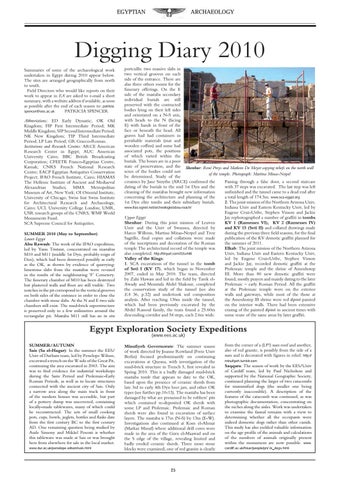
portcullis: two massive slabs in two vertical grooves on each side of the entrance. There are also three others rooms for the funerary offerings. On the E side of the mastaba secondary individual burials are still preserved with the contracted bodies lying on their left sides and orientated on a N-S axis, with heads to the N (facing E) with hands in front of the face or beneath the head. All graves had had containers in perishable materials (mat and wooden coffins) and some had associated pots, the positions of which varied within the burials. The bones are in a poor state of preservation, and the Shenhur: René Preys and Marleen De Meyer copying reliefs on the north wall sexes of the bodies could not of the temple. Photograph: Martina Minas-Nerpel be determined. Study of the Passing through a false door, a second staircase ceramics by Jane Smythe (ARCE) confirmed the with 37 steps was excavated. The last step was left dating of the burials to the mid 1st Dyn and the unfinished and the tunnel came to a dead end after cleaning of the mastabas brought new information a total length of 174.5m. www.sca-egypt.org concerning the architecture and planning of the 2. The joint mission of the Northern Arizona Univ, 1st Dyn elite tombs and their subsidiary burials. Indiana Univ and Eastern Kentucky Univ, led by www.ifao.egnet.net/archeologie/abou-roach/ Eugene Cruz-Uribe, Stephen Vinson and Jackie Jay rephotographed a number of graffiti in tombs Upper Egypt KV 1 (Ramesses VI), KV 2 (Ramesses IV) Shenhur: During this joint mission of Leuven and KV 15 (Seti II) and collated drawings made Univ and the Univ of Swansea, directed by during the previous three field seasons, for the final Harco Willems, Martina Minas-Nerpel and Troy publication of the KV demotic graffiti planned for Sagrillo, final copies and collations were made the summer of 2011. of the inscriptions and decoration of the Roman Elkab: The joint mission of the Northern Arizona temple The architectural record of the temple was Univ, Indiana Univ and Eastern Kentucky Univ, also completed. http://tinyurl.com/33svh8t led by Eugene Cruz-Uribe, Stephen Vinson Valley of the Kings: and Jackie Jay, recorded demotic graffiti at the 1. SCA excavations of the tunnel in the tomb Ptolemaic temple and the shrine of Amenhotep of Seti I (KV 17), which began in November III. More than 80 new demotic graffiti were 2007, ended in May 2010. The team, directed found, mostly prayers and mainly dating to the later by Zahi Hawass and led in the field by Tarek elPtolemaic – early Roman Period. All the graffiti Awady and Moustafa Abdel Shakour, completed at the Ptolemaic temple were on the exterior the conservation study of the tunnel (see also walls and gateways, while most of the those at EA 36, p.32) and undertook soil composition the Amenhotep III shrine were red dipinti painted analysis. After reaching 136m inside the tunnel, on the interior walls. There had been extensive which had been previously excavated by the erasing of the painted dipinti in ancient times with Abdel Rassoul family, the team found a 25.60m some reuse of the same areas by later graffiti. descending corridor and 54 steps, each 2.6m wide.
Egypt Exploration Society Expeditions (www.ees.ac.uk)
SUMMER/AUTUMN Sais (Sa el-Hagar): In the summer the EES/ Univ of Durham team, led by Penelope Wilson, excavated a trench on the W side of the Great Pit, continuing the area excavated in 2003. The aim was to find evidence for industrial workshops during the Saite Period and Ptolemaic-Early Roman Periods, as well as to locate structures connected with the ancient city of Sais. Only a narrow area along the main track in front of the modern houses was accessible, but part of a pottery dump was uncovered, containing locally-made tablewares, many of which could be reconstructed. The sets of small cooking pots, cups, bowls, juglets, bottles and flasks date from the first century BC to the first century AD. One remaining question being studied by Aude Simony and Mikäel Pesenti is whether this tableware was made at Sais or was brought here from elsewhere for sale in the local market. www.dur.ac.uk/penelope.wilson/sais.html
Minufiyeh Governorate: The summer season of work directed by Joanne Rowland (Freie Univ Berlin) focused predominantly on continuing excavations at Quesna, with investigation of the mud-brick structure in Trench 5, first revealed in Spring 2010. This is a badly damaged mud-brick mastaba tomb that appears to date to the OK, based upon the presence of ceramic sherds from late 3rd to early 4th Dyn beer jars, and other OK types (see further pp.10-13). The mastaba has been damaged by what are presumed to be robbers’ pits which contained re-deposited OK sherds with some LP and Ptolemaic. Ptolemaic and Roman sherds were also found in excavation of surface layers. The mastaba is 17m (N-S) by 13m (E-W). Investigations also continued at Kom el-Ahmar (Markaz Minuf) where additional drill cores were made in the area of the Gurn el-Maawad and on the S edge of the village, revealing limited and badly eroded ceramic sherds. Three more stone blocks were examined, one of red granite is clearly
25
from the corner of a (LP?) naos roof and another, also of red granite, is possibly from the side of a naos and is decorated with figures in relief. http:// minufiyeh.tumblr.com
Saqqara: The season of work by the EES/Univ of Cardiff team, led by Paul Nicholson and supported by the National Geographic Society, continued planning the larger of two catacombs for mummified dogs (the smaller one being currently inaccessible). A description of the features of the catacomb was continued, as was photographic documentation, concentrating on the niches along the aisles. Work was undertaken to examine the faunal remains with a view to determining whether all the occupants were indeed domestic dogs rather than other canids. This study has also yielded valuable information on the age profile of the animals and calculations of the numbers of animals originally present within the monument are now possible. www. cardiff.ac.uk/hisar/people/pn/ /e_dogs.html