EGYPTIAN
ARCHAEOLOGY
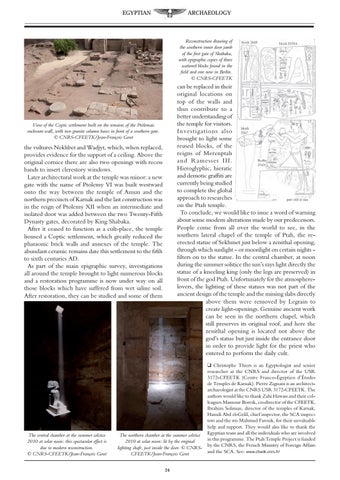
Reconstruction drawing of the southern inner door jamb of the first gate of Shabaka, with epigraphic copies of three scattered blocks found in the field and one now in Berlin. © CNRS-CFEETK
can be replaced in their original locations on top of the walls and thus contribute to a better understanding of the temple for visitors. Investigations also brought to light some reused blocks, of the reigns of Merenptah and Ramesses III. Hieroglyphic, hieratic and demotic graffiti are currently being studied to complete the global approach to researches on the Ptah temple. To conclude, we would like to issue a word of warning about some modern alterations made by our predecessors. People come from all over the world to see, in the southern lateral chapel of the temple of Ptah, the reerected statue of Sekhmet just below a zenithal opening, through which sunlight - or moonlight on certain nights filters on to the statue. In the central chamber, at noon during the summer solstice the sun’s rays light directly the statue of a kneeling king (only the legs are preserved) in front of the god Ptah. Unfortunately for the atmospherelovers, the lighting of these statues was not part of the ancient design of the temple and the missing slabs directly above them were removed by Legrain to create light-openings. Genuine ancient work can be seen in the northern chapel, which still preserves its original roof, and here the zenithal opening is located not above the god’s statue but just inside the entrance door in order to provide light for the priest who entered to perform the daily cult.
View of the Coptic settlement built on the remains of the Ptolemaic enclosure wall, with two granite column bases in front of a southern gate. © CNRS-CFEETK/Jean-François Gout
the vultures Nekhbet and Wadjyt, which, when replaced, provides evidence for the support of a ceiling. Above the original cornice there are also two openings with recess bands to insert clerestory windows. Later architectural work at the temple was minor: a new gate with the name of Ptolemy VI was built westward onto the way between the temple of Amun and the northern precincts of Karnak and the last construction was in the reign of Ptolemy XII when an intermediate and isolated door was added between the two Twenty-Fifth Dynasty gates, decorated by King Shabaka. After it ceased to function as a cult-place, the temple housed a Coptic settlement, which greatly reduced the pharaonic brick walls and annexes of the temple. The abundant ceramic remains date this settlement to the fifth to sixth centuries AD. As part of the main epigraphic survey, investigations all around the temple brought to light numerous blocks and a restoration programme is now under way on all those blocks which have suffered from wet saline soil. After restoration, they can be studied and some of them
The central chamber at the summer solstice 2010 at solar noon: this spectacular effect is due to modern reconstruction. © CNRS-CFEETK/Jean-François Gout
The northern chamber at the summer solstice 2010 at solar noon: lit by the original lighting shaft, just inside the door. © CNRSCFEETK/Jean-François Gout 24
q Christophe Thiers is an Egyptologist and senior researcher at the CNRS and director of the USR 3172-CFEETK (Centre Franco-Égyptien d’Études de Temples de Karnak). Pierre Zignani is an architectarchaeologist at the CNRS USR 3172-CFEETK. The authors would like to thank Zahi Hawass and their colleagues Mansour Boreik, co-director of the CFEETK, Ibrahim Soliman, director of the temples of Karnak, Hamdi Abd el-Gelil, chief inspector, the SCA inspectors and the reis Mahmud Farouk, for their unvaluable help and support. They would also like to thank the Egyptian team and all the individuals who are involved in this programme. The Ptah Temple Project is funded by the CNRS, the French Ministry of Foreign Affairs and the SCA. See: www.cfeetk.cnrs.fr/